
AI for Networks and Networks for AI

AI for Networks and Networks for AI
Networks and Artificial Intelligence (AI) have a symbiotic relationship with each benefiting from the prosperity of the other. While AI takes on the responsibility of creating and curating content, networks take on the responsibility of transmitting it to and from the content consumers. Networks are the lifeblood of the ecosystem moving bits and bytes just like oxygen to the consumers.
AI For Networks
In the last three years, we have seen exponential growth of AI and Machine Learning (ML) applications. Every industry from defense to healthcare to fashion design has seen some form of AI infiltrate its operations. The telecommunications industry has been rightfully slow on the uptake of AI. Network resiliency is always prioritized over network optimization and until recently the scope of disruption by AI in networks was unknown.
Recently, the FCC Technological Advisory Council (TAC) released its whitepaper on AI/ML in networks which consisted of recommendations on use of AI/ML for rural networks. More details on AI for Networks can be read in Section 4.2.3 of the 2025 FCC TAC AI/ML Working Group report.
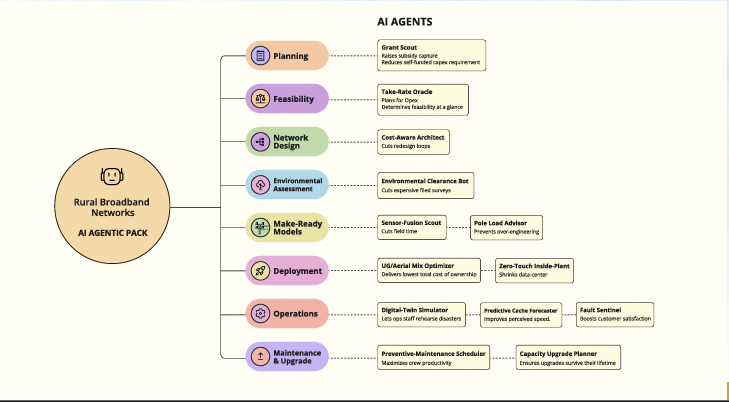
The AI Agents for Networks data is surmised in the graphic below. It is important to note that these agents will form interconnections and collaborate with each other instead of operating in a vacuum. The formation of recursive cycles within AI agents with reinforced learning is inevitable. As the illustration shows, AI/ML can be used in multiple stages of the lifecycle of a rural network allowing such networks to improve both resiliency and experience. Larger networks such as T-Mobile have partnered with OpenAI to create the ‘IntentCX’ platform which embeds AI into their customer experience engine. The move to improve CX by using AI will lead to enhanced loyalty and reduced churn while simultaneously driving subscribers to higher tiered and more profitable plans. Comcast is working with Broadcom on the ‘Janus’ initiative which enables network nodes to adapt using machine learning thereby leading to better resiliency and performance.
Networks for AI
The networks for AI can be classified into three segments: Middle Mile networks between AI datacenters, Last Mile networks for end users, and Smart Grid networks for grids powering the datacenters.
Middle Mile Networks
A fiber network is needed between AI data centers so that workloads can be distributed. This is the middle mile network that serves datacenters and connects ISPs and other enterprises to the datacenter. The current philosophy of AI compute datacenter operators is to build large datacenters with hundreds of megawatt capacity.
Unfortunately, there is an upper limit to the amount of power available in a single location. In the U.S., new power generation facilities take a long time to become operational due to regulations. This necessitates a distributed architecture that will require multiple data centers sharing workloads. The existing middle mile fiber infrastructure in America today is extremely limited with very few fiber strands available for expanded use. This problem is exasperated in rural America where operators prefer to establish AI datacenters owing to cheap land, power and readily available workforce.
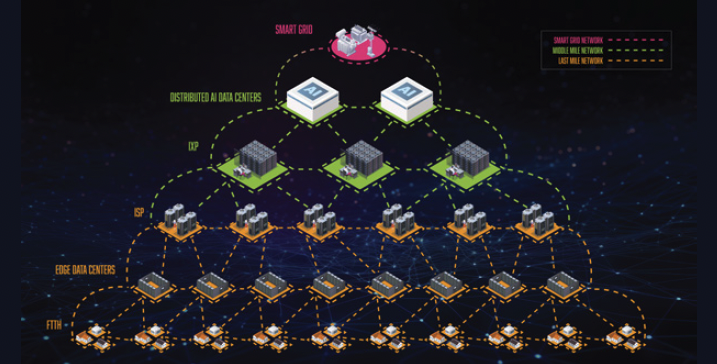
Construction of new middle mile fiber strands which will connect AI datacenters and these datacenters to Internet Exchange Points (IXPs) is the first step towards gaining dominance in the AI war with other countries. This will require significant investment in rural America. The most cost-effective and scalable way to build such networks is to interconnect existing rural last mile networks2.
Last Mile Networks
Last mile networks enable the consumption of content generated using AI. The viability of any AI enabled application is dependent on two factors within the last mile network – capacity and latency.
Capacity determines how much data can be pushed back and forth between consumers and AI data centers. Raw and unfiltered data from the consumers to edge data centers (EDCs) or distributed AI data centers will generally require more upload capacity than computed and curated data from the data centers to the consumers. This makes symmetric speeds a vital requirement for AI applications which is only achievable on fiber networks. As referenced in the FCC TAC report1, LEO satellite and fixed wireless networks with asymmetric speeds will be hard pressed to unleash the full AI experience for consumers.
Latency or the digital round trip time determines if data can make it back and forth without degrading the consumer experience. This is generally not a concern for urban areas which are in proximity (50 miles or less) of a data center or IXP. However rural areas which are located hundreds of miles away from such a hub can experience latencies greater than 50ms. The primary application of the internet of yesterday was video streaming, which could cope with latencies as high as 100ms. The internet of the future is being built with low-latency applications requiring sub 7ms latencies3. This will require a large number of edge data centers which will cache computed data from the AI data centers to serve rural America.
As mentioned above, AI datacenter operators love to build in rural America. Unfortunately, they create expressways to the nearest population center and completely bypass serving the rural population where these data centers physically exist. One solution to remedy this is to set up regional rural IXPs which will provide enough enticement to the datacenter operators to connect to them, thereby serving rural populations. Another solution is for local governments to require AI data centers to connect to the local ISPs directly as part of the negotiations.
Smart Grid Network
Telecommunications and IT applications of the past have generally been very power efficient, not requiring large amounts of electricity. The AI age has flipped this script on its head with each AI datacenter requiring hundreds of megawatts of power. Instead of connectivity, power has become the primary driver of these datacenters.
The current national grid in America does not have the capability to support enough AI data centers that will assure our AI dominance over other countries. Smart grids powered by a fiber network improve the efficiency of existing electric grids, providing the necessary stop gap needed as we ramp up the deployment of AI data centers. Smart grids also allow for smart decisions in when to use available electric capacity for datacenters and when to use it for the general population. As power generation becomes more diverse, the inclusion of intermittent sources such as solar and wind power will require smart decisions in managing large and small loads.
Final Thoughts
AI and telecommunication networks are intertwined with each other and with time we will find it difficult to differentiate between the two. Nodes and equipment that currently run the telecommunications infrastructure will incorporate AI to serve AI content to end user thereby creating an ecosystem where one cannot be separated from the other.

Related Content

AI Has Entered the Chat FIBER BROADBAND ASSOCIATION 3RD QUARTER CEO UPDATE Our society is on the verge of several…

Microsoft Scales Up Hollow Core Fiber Production Creating better fiber is a non-trivial task. Today’s G.652/G.657 single-mode fiber has proven…

Behind the Scenes of ThoughtWaves In the Fall of 2024, FBA President and CEO Gary Bolton and I sat down…