AI Has Entered the Chat

AI Has Entered the Chat
FIBER BROADBAND ASSOCIATION 3RD QUARTER CEO UPDATE
Our society is on the verge of several seismic technology-driven paradigm shifts that will change everything, not only in our industry, but across other industries and society at large. We are rapidly approaching substantial tipping points which will feed each other to create a perfect storm of innovation that requires a robust national fiber optic infrastructure critical for the decades to come.
Quantum computing and quantum networking, bioengineering, and artificial intelligence are all critical tipping points that will unlock unprecedented growth and wealth. It remains to be seen how some of these technologies will be harnessed and how pervasive they will become over time, but the general consensus is that artificial intelligence (AI) will fuel the future of everything.
But to get there, AI requires massive amounts of water, energy, and fiber. Recently, OpenAI unveiled plans for a $1 trillion build-out of computing warehouses across the U.S. and abroad. Earlier this quarter, the Trump Administration rolled out America’s AI Action Plan, focused on three pillars: accelerating innovation, building American AI infrastructure, and leading in international diplomacy and security.
At the NTIA listening session on AI infrastructure requirements, speakers before and after me emphasized the absolute need for resilient national fiber optic infrastructure to support our nation’s AI future. Research from Recon Analytics also found a direct correlation between AI usage and the broadband quality.
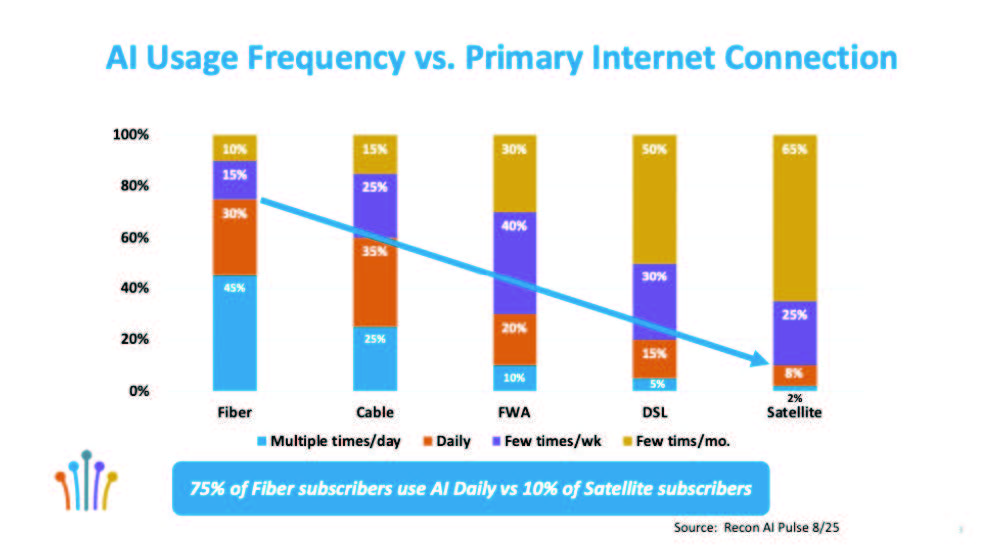
The chart below illustrates that 75% of homes with fiber use AI daily, versus only 10% of those connected by satellite.
There is a clear disconnect with the Administration’s stated priorities on AI and recent actions discounting the absolute benefits of fiber for both today’s society and generations to come.
Four years ago, Congress signed the Investment in Infrastructure and Jobs Act (IIJA) into law which provided $42.45B in funding for the NTIA BEAD program to ensure that every American has access to reliable broadband service. U.S. Commerce Secretary Howard Lutnick issued revised policy guidance on June 6, 2025 [4], which stripped out the burdensome, non-statutory requirements from the Biden Administration and eliminated the fiber preference. It implemented a technology neutral approach which included a 90-day Benefit of the Bargain (BOTB) round for states and territories to provide preliminary awards with their funding allocations.
The BOTB round put a hard focus on low cost and minimizing broadband deployment spending. At magazine press time, all states except California had submitted Final Proposals. It appears that twothirds of the eligible BEAD locations will be built with fiber, while about 12% will go to fixed wireless access, 2% to hybrid fiber coax (HFC), and the around 21% of the locations will be serviced by Low Earth Orbit (LEO) satellite providers SpaceX and Amazon.
The original intent of IIJA was to provide universal access to robust, scalable networks. The focus by the U.S. Department of Commerce to avoid funding terrestrial facilities, while “saving” $20 billion, will leave nearly 1 million hard to reach rural homes and businesses without access to reliable, resilient, and scalable high-speed broadband infrastructure.
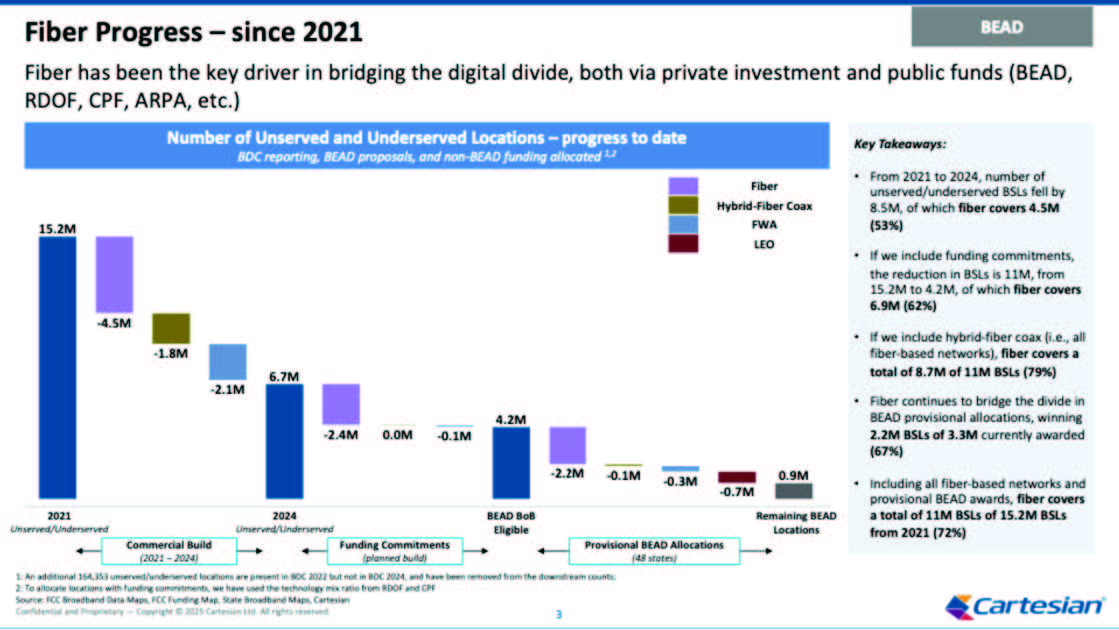
Still, our industry has stepped up to make significant progress in connecting the nation’s unconnected prior to the availability of BEAD. Four years ago, there were over 15.2 million unserved and underserved homes across the nation. Our industry has connected all but 4.2 million BEAD eligible locations using private capital investment, in addition to federal and state subsidies. CostQuest reports that 33% of the fiber deployed in rural America was made possible by these non-BEAD government subsidy programs.
Cartesian’s analysis in the slide below illustrates how the fiber industry has addressed 11 million of 15.2 million unserved and underserved locations that the IIJA intended to connect.
The NTIA BEAD program will help us get fiber to two-thirds of the remaining 4.2 million unserved and underserved locations. Unfortunately, over 840,000 rural families will be left with LEO satellite as their only option. Meanwhile, the broadband landscape continues to change, as it always does when new innovations emerge and change the digital landscape.
A year after the introduction of BEAD, ChatGPT was introduced on November 30, 2022, and became the fastest adopted technology in history, reaching 750 million weekly active users in under three years. The IIJA did not anticipate the explosive emergence of AI platforms and services and the critical fiber infrastructure needed to support their growth and usage.
Given that NTIA will have over $20 billion in residual BEAD funding, FBA is advocating that this surplus be directed to building AI critical fiber infrastructure, middle mile fiber, and workforce development. These vital infrastructure priorities are being supported by multiple Senators and Governors in both parties. The fiber industry will be successful in connecting every home with fiber, but our mission has been significantly elevated as we also work to build our nation’s critical AI fiber infrastructure by 2040 and beyond.
FBA Q3 Performance
In the third quarter of 2025, the Fiber Broadband Association has achieved its 19th straight quarter of growth. Financially, we ended August with continued strong revenue growth, outperforming our year-to-date budget target by 16.5%. FBA operations revenue also outperformed the budget by 23% while tightly managing expenses.
The key contributors to FBA’s operations revenue growth were membership revenue, growing over 12% year-overyear, strong regional events, investment income, and nonconference sponsorships. We also saw strong 22% annual revenue growth from our Fiber Connect 2025 annual conference.
Regional Fiber Connect Workshops
We held regional Fiber Connect workshops in Toronto, Canada, in August and in Spokane, Washington, in September.
We are excited about the tremendous response and excitement that we are seeing from Canada. Our new Canadian working group, led by Co-Chairs Robert Petruk (Dura-Line), Ian Oliver (Globema), and Justin Cameron (Talley), met in person the day before our Toronto event is highly engaged. We expect to see strong work products and advocacy recommendations come out of this working group as Canada strives to connect its northern remote areas and First Nations. For instance, work is underway on our first Economic Impact Study on Saskatchewan, leveraging data we learned during one of the Toronto keynotes.
One of the highlights in Spokane was the rollout of our partnership with Dolly Parton’s Imagination Library. We feel our members and the communities they serve will significantly benefit in our shared mission to elevate the quality of life for generations to come.
We will finish 2025 with Regional Fiber Connect workshops in Scottsdale in October and in Kansas City in November. Our final event of the year will be our Premier Members meeting in Palm Springs on December 8 and 9.
FBA Research in Q3
Our committees and working groups are focused on developing and publishing studies and industry best practices. During the third quarter, FBA’s committees, working groups, and research partners published the following resources, studies and industry best practices:
- “Permitting for Fiber Network Projects: The Good, the Bad, and the Ugly.” (FBA Deployment Specialists Committee, September 2025)
- “Employer Workforce Preparedness in the Fiber Broadband Industry: How Build-Ready are We?” (FBA and NCTI, September 2025)
- “Strengthening the Fiber Broadband Supply Chain.” (FBA Supply Chain WG, September 2025)
- “The Under Appreciated Need to Enable AI and Data Center Growth: Increased and More Strategic Fiber Interconnections.” (FBA and RVA, July 2025)
- “Middle Mile Networks: The Backbone and Highway to Affordable Broadband Innovation.” (FBA Middle Mile Working Group, June 2025)
- “Bridging the Gap: Why Congress Must Invest in Middle Mile Broadband Networks.” (FBA Middle Mile Working Group, September 2025)
FBA OpTIC Path Fiber Optic Workforce Development
We have now graduated 1,167 students from our OpTIC Path training program from over 25 community colleges, high schools, and private training institutions across 16 states leveraging the program. We also developed a series of stackable micro-credentials that align with specific job roles, creating a structured career ladder for technicians.
Our newest learning institutions include NoaNet in Washington; Ashland University and Youngstown State in Ohio; the City of Pharr, Texas; and SUNY Brockport in New York. Our tribal schools and pilots include the Eastern Band of Cherokee Indians in North Carolina; Benteh Steam Academy of the Knik Tribe in Anchorage, Alaska; and Oneida Nation in Green Bay, Wisconsin.
FBA Q4 Goals
As we move into the fourth quarter of 2025, our top-level goals are to continue to work closely with the state broadband offices and the Administration to advance and accelerate fiber deployment; work closely with the Administration and Congress on plans and policies to build out our nation’s fiber-based critical AI infrastructure; educate policymakers on the co-dependency of AI and fiber; and complete a comprehensive membership study and implement the resulting recommendations.
By the time you receive the magazine, we will have executed the FBA Federal Public Policy Fly-In in Washington, DC, in October; FBA Regional Fiber Connect events in Scottsdale (October), Kansas City (November), with our Premier Members meeting taking place in Palm Springs in December. We also executed FBA LATAM’s Fiber Connect event in Bogota, Colombia, in October.
As our mission to connect every home and business with fiber by the end of the decade becomes reality in the days and months ahead, we are beginning to see the immense fiber opportunity for the next decade and beyond.
Our volunteer leadership and the valuable work products generated from our working groups continues to impress me. We are also so very fortunate that our board of directors, led by FBA Chairwoman Ariane Schaffer (GFiber), is highly engaged and very hands on, working with our committees and working groups, and doing what they can to advance our industry. For example, FBA’s treasurer and immediate past chair, Jimmy Todd (CEO, Nex-Tech) testified before Congress on September 3, in the House Small Business Committee, discussing the critical role that fiber plays to support the topic of “Wired for Growth: How Expanding Broadband Can Revitalize Rural Small Businesses.”
My excitement and passion for the future of our industry and the FBA continue to grow, fueled by what I believe we can become and the numerous contributions we are making to our industry and society, both in the near-term and for generations to come.

Related Content
AI for Networks and Networks for AI Networks and Artificial Intelligence (AI) have a symbiotic relationship with each benefiting from…

Microsoft Scales Up Hollow Core Fiber Production Creating better fiber is a non-trivial task. Today’s G.652/G.657 single-mode fiber has proven…
Behind the Scenes of ThoughtWaves In the Fall of 2024, FBA President and CEO Gary Bolton and I sat down…