BEAD Funding Moves Forward

BEAD Funding Moves Forward
With a summer 2025 restructuring by the National Telecommunications and Information Administration (NTIA) dubbed the “Benefit of the Bargain,” the Broadband Equity, Access, and Deployment (BEAD) program is now moving forward again.
As of October 15, 2025, all states and territories except for Washington, D.C. and California had submitted Final Proposals, according to Wes Robinson, Director of Regulatory Affairs, Eastex Telephone Cooperative (Eastex), with California having received an extension until November 21.
Robinson has been tracking the progress of BEAD funding and the choices states and territories have been making in deploying fiber and alternative technologies. Eastex currently serves 23,000 rural customers across six noncontiguous areas in Eastern Texas with 21 exchanges.
“Our service area is very rural,” said Robinson. “We don’t have any large businesses in our area, not yet. The Livingston area, north Houston, is growing. Polk County is very excited about some of the changes they’re seeing. There’s a new roadway that’s going in the I-69 corridor that’s going to connect Mexico to Canada, and they think that that will bring some business to the Polk County area.”
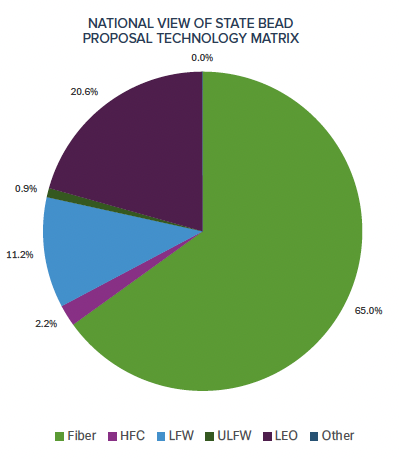
Based on the Final Proposals less California’s, about 65% of BEAD locations will be connected by fiber according to Robinson’s calculations, followed by LEO (20.6%), licensed fixed wireless (11.2%), HFC (2.2%), and unlicensed fixed wireless (0.9%).
“This feels about right,” said Robinson. “I think we all knew that we were going to have to use alternative technology to stay within budget to deploy broadband to everyone. Nearly two-thirds fiber is a reasonable number. Each state has funded fiber to varying degrees. I’m grateful to see that the states have found ways to look at scalability very carefully and to make sure that the technology they’re putting in will meet next generation needs as much as they can.”
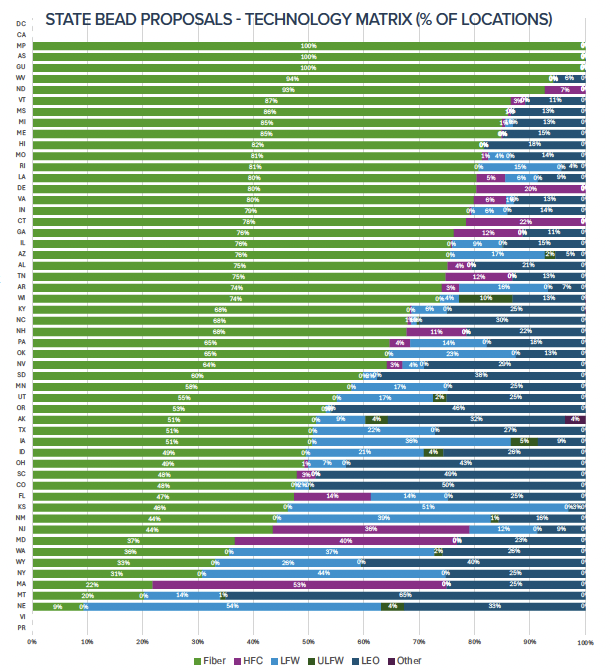
Robinson notes that some states and territories are spending a significant amount of money on fiber and reaching most to all of their locations, sometimes at a significantly lower fraction of their initial BEAD allocation. “Guam is using 1.2% of its funding, but they got fiber to every location except for two,” said Robinson.
States using fiber to reach the vast majority of their BEAD eligible locations include West Virginia (94%), North Dakota (93%), Vermont (87%), Mississippi (86%), Michigan (85%), Maine (85%), Hawaii (82%), Missouri (81%), Rhode Island (81%), Louisiana, Delaware, and Virginia (all at 80%). Texas will currently reach 51% of its nearly 243,000 locations with fiber, but the state also has additional resources it could choose to bring to bear.
“Texas passed a voter initiative two years ago that set up a $1.5 billion broadband infrastructure fund, so we have this extra money that theoretically we could use,” said Robinson. “They’re using some of that [today] to help companies with the 25% BEAD match.”
A number of service providers are anticipating BEAD funding to be distributed through state broadband offices in the first quarter of 2026 with construction starting in the second half of the year. For example, on October 3, 2025, Brightspeed announced it expected to receive over $528 million in BEAD program funds across 17 states to expand its network.
“The states have just issued preliminary awards,” said Pamela Sherwood, Vice President of Regulatory, Compliance and Broadband Office, Brightspeed. “We have one more state we’re waiting to hear from, Texas, so that will take it to 18.”
Sherwood noted that there was still more federal review ahead before funding is finally released, with NTIA reviewing projects to make sure there is no existing broadband coverage overlap or if eligible locations had been removed from maps due to updates, and a final review by the Grant officer for the BEAD program, the NIST Officer.
“After that, it comes back to the states, where they execute grant agreements with the awardees and begin the project kickoff,” said Sherwood. “From that point, we will all go through a process of getting the necessary permits to begin construction and the authorization to proceed. There’s an additional federal requirement for permitting under the National Environmental Policy Act and historical permitting.”
Brightspeed’s footprint extends across 20 states when it acquired the incumbent legacy service areas from Lumen Technologies in 2022 and currently passes over 2.5 million locations. The service provider’s business plan has been to deploy fiber as far and as deep into those territories as possible, recognizing there are some locations and areas that would require some additional capital.
“State and now federal broadband grant programs have leaned in to facilitate that additional capital investment for fiber,” stated Sherwood. “Brightspeed’s BEAD success is twofold. In our footprint, we have a lot of grant-eligible locations, meaning customers didn’t have high-speed broadband access. The second thing that has led to success is that we’ve been working on broadband grants since we started in 2022. Under ARPA, Capital Projects Fund, and a number of state broadband programs, we had already secured almost $300 million across over 135 projects and 15 states. We’ve developed a track record of being able to apply for, win, and build successful broadband networks under grant programs.”
Sherwood points out there are a number of hurdles ahead that service providers still face, ranging from limited resources at local and state permitting offices to process permits at those levels, pole attachment procedures and make ready work with the potential for replacement.
“In terms of a broadband project, there’s a lot of behindthe- scenes work that happens before you get to turning dirt and hanging wires,” Sherwood said. “There’s a lot of evaluation, checking addresses, doing your high-level design, having your engineers walk the site and making sure the construction project as designed is buildable and feasible. In some cases, it could be a good six months of that permitting, evaluation, and design stage before you ever get to construction.”
But BEAD won’t be the last stop for Brightspeed applications. Due to map changes, RDOF defaults, and state grant availability, Sherwood expects additional opportunities to make up for areas that don’t qualify for BEAD.
“A number of states are looking at running another round of grants,” Sherwood said. “For example, Kansas just opened what they call BAG 5.0. Applications are due at the end of October. North Carolina has a number of state grant dollars that are still available. Once BEAD funding is done and all [uncovered] locations are identified, they anticipate leaning in for some of that state funding to cover locations that got left behind.”

Related Content
Fiber for Breakfast Week 40: Arkansas’s Broadband Momentum Arkansas entered this decade with a lot of broadband work left to…
For tribal nations, sovereignty and the preservation of indigenous cultures is fundamentally intertwined with the scrutiny, acceptance, and adoption of the latest technologies. This path provides a sustainable bridge between generations while creating jobs and strengthening ownership and self-governance.
Alabama-based Dragonfly Internet is a relatively new service provider but traces back its leadership and experience roots to owner ITC Holding Company, LLC, a venture and management firm with decades of involvement in wireline, cellular, and internet service providers.