
Fiber’s 50G Future (Says Cable)

Fiber’s 50G Future (Says Cable)
Fully unlocking the potential of fiber is something many companies and organizations around the world are investing in, including some very non-traditional names.
CableLabs has taken the first steps to unlock more speed and performance out of a single strand of glass to deliver higher speeds, lower latency, and reduce power consumption.
At SCTE TechExpo 25, held in Washington D.C., on September 29-October 1, 2025, CableLabs Chief Technical Officer Phil McKinney discussed the future of DOCSIS in a morning keynote address, with fiber making a surprising appearance towards the end. The industry plans to squeeze every last ounce of capacity from its legacy hybrid fiber coax (HFC) plant, with immediate plans to add extensions to DOCSIS 4.0 to reach 25 Gbps speeds and a longer-term vision to hit 50 Gbps by throwing 6 GHz of RF spectrum onto the wire.
“When you are walking the show floor, you will see vendor partners with 3 GHz support and capabilities,” McKinney said. “3GHz will deliver 25 gigabits of aggregate capacity. Your customers won’t just get faster downloads, this will create an experience that is magical, awaking capabilities and experiences never before anticipated.”
While the parts and pieces to get to 25G over HFC are now available, no cable operators announced deploying the newly revealed technology in a production environment, while the path to 50G HFC is much more aspirational. Inviting the industry to collaborate on the next step to use 6 GHz of spectrum to get to 50G HFC, McKinney highlighted that more speed would be key to reaching “the adoptive era” of networks that would use AI to learn from and anticipate user needs, seamlessly adapting to provide quality service and eliminating service calls through predictive intelligence.
But it was McKinney’s discussion of fiber which caught the audience’s attention.
“We’ve invested seven years of work in coherent optics,” said McKinney. “Many of you are deploying fiber in the form of XGS-PON. Coherent optics is that next level. Both IEEE and ITU are embracing coherent optics as this next generation.”
McKinney stated that CableLabs and its members are now the largest holders of intellectual property and patents in coherent optics and have already looked into a mindboggling future.
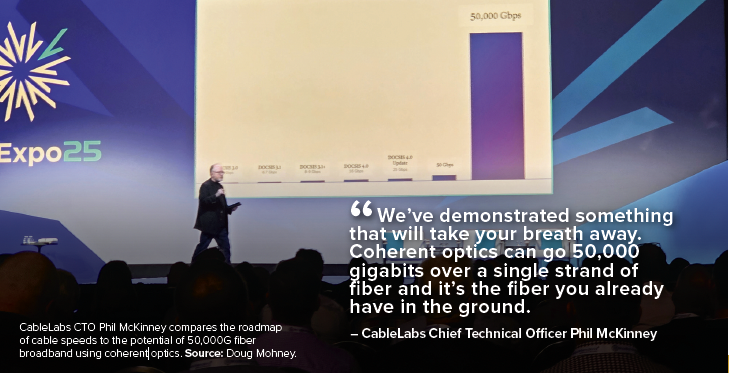
“We’ve demonstrated something that will take your breath away,” said McKinney. “Coherent optics can go 50,000 gigabits over a single strand of fiber and it’s the fiber you already have in the ground. This is not an esoteric fiber, this is an optical technology. We were talking about going all the way up to 50 gigabits and now, with coherent optics, we take that up to 50,000 gigabits. The future capacities of our networks are literally unlimited. Multiple pathways, multiple options, multiple approaches that any operator in the world can take advantages of.”
Already cable operators have deployed coherent point-topoint optics over fiber and McKinney noted that coherent PON is under development. The last edition of Fiber Forward (Q3 2025, pages 39-40) examined the rollout of 25G PON around the globe, field trial deployments of 50G PON, vendors indicating that 200G PON is likely to be the next international standard, and Ciena has now delivered long-haul speeds of up to 1.6 Tbps. Certainly the fiber industry has plenty of room on existing deployed media to continue to increase speeds across the network from edge to core.

Related Content
AI for Networks and Networks for AI Networks and Artificial Intelligence (AI) have a symbiotic relationship with each benefiting from…

AI Has Entered the Chat FIBER BROADBAND ASSOCIATION 3RD QUARTER CEO UPDATE Our society is on the verge of several…

Microsoft Scales Up Hollow Core Fiber Production Creating better fiber is a non-trivial task. Today’s G.652/G.657 single-mode fiber has proven…