
The FBA Chair Moving Fiber Forward in 2025

The FBA Chair Moving Fiber Forward in 2025
Literacy is a key stepping stone to being a fully functioning participant in today’s digital world and tapping into the vast resources of the internet, from e-commerce and basic government services to applying for employment, working from home, and accessing quality healthcare.
The Fiber Broadband Association continued to grow and thrive this year, increasing its total membership, research output, events, and participation. Over the past four years, Fiber Forward has conducted interviews with the outgoing FBA chair to discuss the state of the association, its accomplishments, and challenges.
“FBA continues to add so much value to the membership, both to individuals looking to grow their career, as well as to companies with additional resources,” said Ariane Schaffer, the 2025 FBA Chair and GFiber’s Head of U.S. Federal and State Policy. “We’ve had tremendous success in our committees this year. We’ve had more engagement in the committees and working groups. We’ve started new ones that are publishing more papers and research than ever before. These individuals and companies are coming together, putting their brightest heads together, and publishing. That’s been really great.”
FBA now has over 20 committees and working groups, with many of them generating resources such as white papers, studies, and industry best practices in areas such as supply chain, middle mile, and deployment. The newly formed Canadian working group is growing very quickly, focusing on the areas of middle mile backhaul availability, design and construction efficiencies, and First Nations outreach.
“Another huge success this year has been workforce development and the OpTIC Path™ training program,” said Schaffer. “As of mid-September 2025, we have 1,075 graduates from that program. With any program, the first few years you want to get it right, you want to make sure you know you’re iterating. We’re at a point now where we are proud of the training we’ve put together, the materials, the content, and it’s been a huge success on that front.”
Public policy is another area where Schaffer has seen substantial progress over the past year due to the efforts of FBA. “I’ve been incredibly impressed with Marissa Mitrovich, who came on almost three years ago now as Vice President of Public Policy and the newly hired Tinae Bluitt from Capitol Hill,” said Schaffer. “We have seen the first policy summit be a huge success along with the continued membership fly-ins into Washington.”
With more industries investing in fiber optics and the need for increased bandwidth to support applications such as AI, there is still plenty of work ahead for FBA.
“There are still a number of significant challenges to deployment,” said Schaffer. “First, I would highlight permitting. We are trying to support our local communities who have seen an influx of infrastructure development, including fiber builds to their cities. Certainly, this means that there needs to be a priority on permitting reforms in local communities. This is an ongoing effort we’ve had over the past two years.
The permitting paper that came out of the permitting summit last year continues to have relevance, with its case studies and concrete examples of ways communities have overcome permitting hurdles.” The permitting paper continues to hold value, Schaffer said, because of the shared goal of stakeholders to get everyone connected to fast and reliable internet, with the four case studies being distributed around the country, enabling communities to find permitting improvement methods that work and can be replicated in their own municipalities.
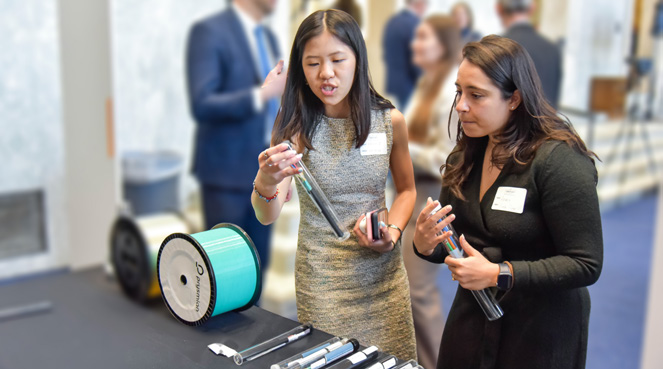
*At Fiber Day on the Hill 2025, FBA Chair Ariane Schaffer (R) discusses the benefits of fiber with congressional staffer. Source: Fiber Broadband Association.
“Another focus is locates,” said Schaffer. “The locates process across the country continues to be a challenge with delays, mismarked utilities, and bad actors not being held accountable. Telecommunications facilities, as well as natural gas facilities, remain the most frequently damaged types of infrastructure across the country. Sewage, water, and telecom are the leading perpetrators of the damage. Damage leads to outages, customer frustration, the service provider has to go out and pay for repairs. If the system was working well, we could instead spend that time focused on connecting more households.”
Access, affordability, and connectivity will all continue to be a focus for FBA, even as overall physical connectivity continues to increase through private investment, federal programs such as BEAD, and state investment.
“Even with physical access to broadband outside of their door, many households might not be able to afford service,” Schaffer said. “This is where I would challenge our membership and our industry to really meet the moment, to continue to find ways to ensure everyone is online, no matter what their financial circumstances. That directly ties to public policy— it’s not just, ‘if you build it, they will come.’ We need to ensure folks have digital navigators in their communities and a trusted partner they can work with; getting on the internet can be scary for some and we need to acknowledge that.”
Schaffer is also proud of the way that the Fiber Broadband Association has active participation and engagement by its members on its goals, organization, and operations.
“I think that makes FBA particularly unique compared to other associations,” Schaffer said. “It’s not ‘our way or the highway.’ It’s grown from within the membership and we are led by the members. It’s a particularly unique way to run an association.
“We have committees like Women in Fiber. We’re investing in training the next generation of leaders, inclusive of age and gender. The focus is making sure we continue to have strong leaders now and for the future, through elevating people through co-chair positions or working group leaders, and mentorship opportunities through the various committees. There are many subsets of the industry —the Tribal Broadband Roundtable, Women in Fiber, the Canada Working Group —that have been invested in to ensure FBA continues to thrive and grow.”
Schaffer also sees FBA working on continued improvement of the in-home experience, making sure the devices there are able to deliver the full potential of multi-gig symmetrical speed services carriers are rolling out today. “We’ve seen great success with Wi-Fi 7 to increase speeds in the home,” she said. “We’re going to need to continue to iterate on that in the equipment manufacturing community, but that’s very much integrated into the service provider ecosystem. I’m excited to see where that goes.”
Schaffer started her time with FBA working on the Public Policy Committee, eventually serving as co-chair, and then as board liaison to the committee, an area where she expects to engage in moving forward.
“I think where you can find me post-Chair is continuing to ensure that FBA’s voice is heard and respected in Washington, D.C., and state capitals across the country,” said Schaffer. “The second focus I have is with crossindustry relations, such as with the Common Ground Alliance. It’s easy to forget when you live in your own industry that there are a lot of others that have similar interests. How can we strengthen our alliances? How can we learn from other industries that have been around longer, but also, how can we share what we’ve learned in best practices with other industries?”

Related Content
AI for Networks and Networks for AI Networks and Artificial Intelligence (AI) have a symbiotic relationship with each benefiting from…

AI Has Entered the Chat FIBER BROADBAND ASSOCIATION 3RD QUARTER CEO UPDATE Our society is on the verge of several…

Microsoft Scales Up Hollow Core Fiber Production Creating better fiber is a non-trivial task. Today’s G.652/G.657 single-mode fiber has proven…