
Increasing Utility Power with Fiber


Increasing Utility Power with Fiber
EPB started installing the first parts of its smart grid in 2009, leveraging an investment in fiber optics to ultimately connect 1,200 automated switches across its electrical plant along with over 200,000 smart meters across its 600 square-mile Chattanooga, Tennessee, service area. In its 15 years of operations, the smart grid delivered considerable benefits to EPB customers, including a 50-60% annual decrease in outage minutes that translated to up to $55 million in savings per year by helping them avoid spoilage of food, lost productivity due to the shutdown of equipment and ecommerce, and other negative impacts.
But the municipal utility has never stopped at “good enough” and continues to constantly seek ways it can leverage its fiber investment to improve the quality of life and economic well-being of the community it serves. Its latest project is extending the benefits of its smart grid by building microgrids around the city, a venture that will deliver a combination of increased uptime, additional reliability across the region, and lower electric bills for consumers and businesses.
“We’re moving into the distributed energy resource area as the next phase of building out our overall advanced grid infrastructure,” said Ryan Keel, EPB President of Energy and Communications. “The key difference microgrid implies and requires is the ability to produce or store and dispatch power in remote areas of the system. I could have an area of our electric system that is isolated from the traditional grid, and I’ve got an energy source there that can maintain service to a group of customers during that time while they are not connected to the traditional grid.”
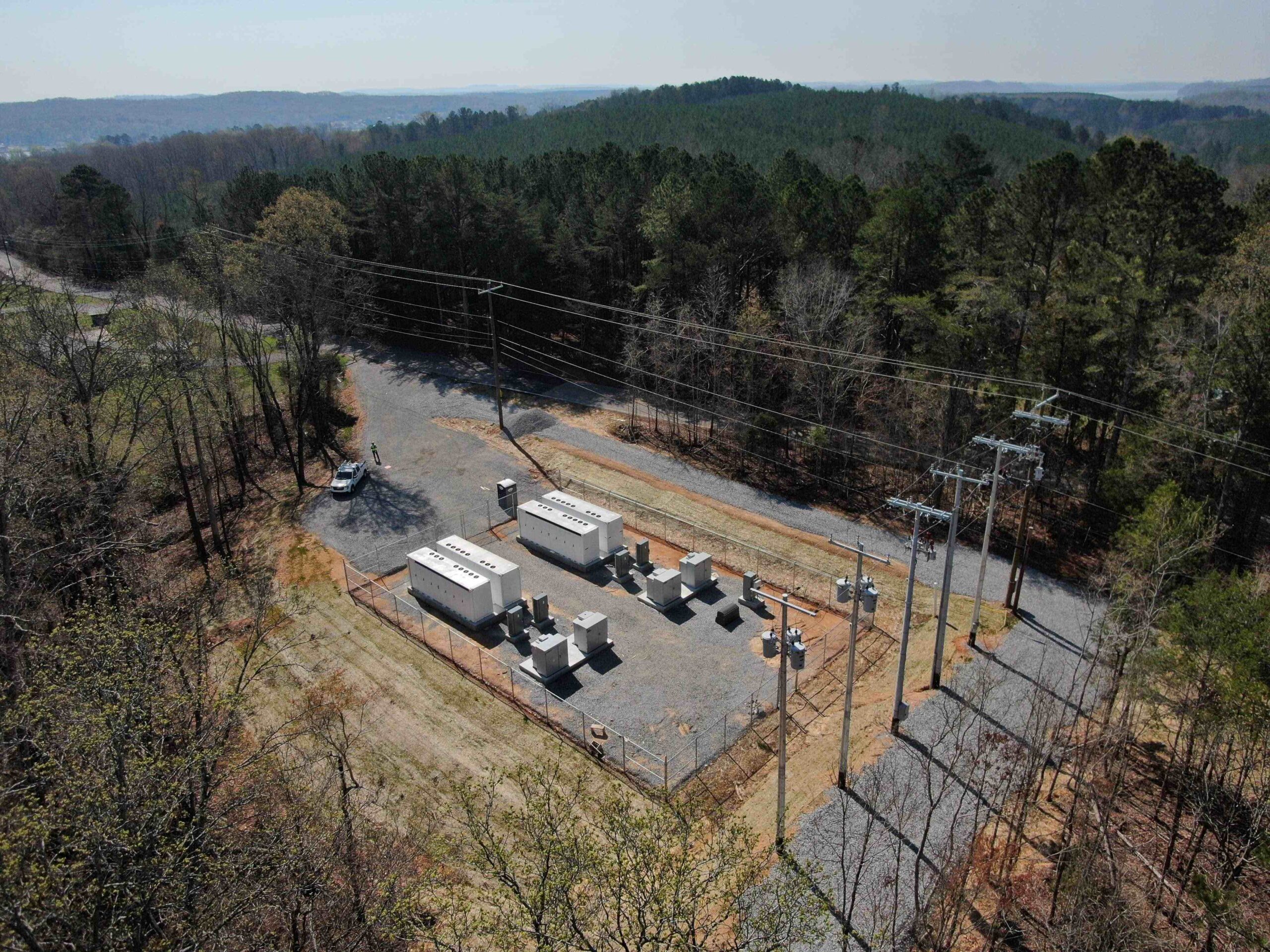
Microgrids put batteries into the power infrastructure to store electricity during off-peak time for cost savings and provide service to customers when primary distribution lines go down. Source: EPB
Fiber connects all the utility’s pieces together in a safe and secure manner, enabling EPB to monitor, fine tune, and diagnose problems in real time. For example, if a tree falls across a distribution line to a community, service would be cutoff, with the smart grid able to reroute power across the functioning parts of the network to keep up as many customers as possible while operators are able to quickly identify where the break is, so EPB can promptly dispatch repair crews and restore service.
“If you picture our power system, it’s a finite area with a boundary,” said Keel. “There are areas on the outskirts of the power system where we have long radial lines where we go to the edge of our system and we don’t have another circuit on the other end to provide that backup. Most of our distribution automation requires you to have neighboring and adjacent circuits that tie together and build a mesh, with the automated infrastructure switching around that mesh with all 1,200 intelligent switches that we installed.
“Out on the edges, you have some areas that are more vulnerable, where we may have a line that has no backup, that goes and serves 300 or 400 customers, and in one case in particular, dead ends right at the Tennessee River. There’s no practical way to get another circuit.”
For many reasons, including challenging geographical boundaries and the associated costs to reach them, it is easier to install battery storage at the edge of the network than to build more power lines for redundancy with their associated maintenance and repair overhead.
EPB is targeting specific locations where it has higher than average outage times and frequencies for its customers to place energy storage systems. If the community has its own microgrid, it effectively has its own UPS that can maintain power while crews are working to restore service. Today, six energy storage sites are in operation, each one a flat pad site hosting containers packed with lithium-ion-phosphate battery with them adding up a total of 45 megawatts (MW) of system power storage. Many sites will be added over the next two to three years, increasing total system storage to between 100 MW and to 150MW. Fiber provides high-speed secure communications to these sites, seamlessly integrating them into EPB’s power grid operations.
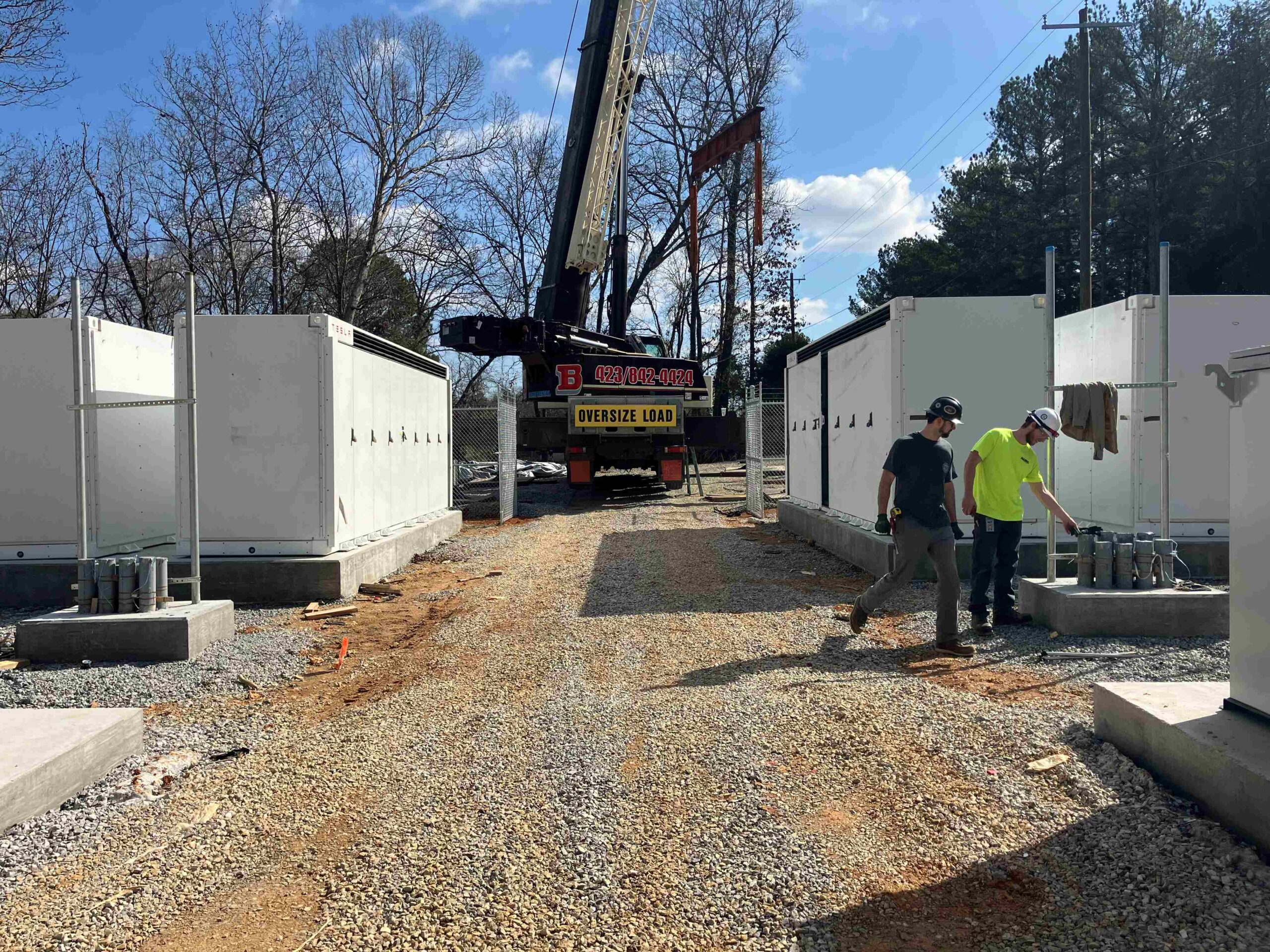
Building a microgrid site is uncomplicated, requiring a flat piece of land to store large batteries and fiber to provide secure communications. Source: EPB
Installing energy storage does more than simply increase reliability and availability but also provides a pathway to a medium-term return on investment. “Our wholesale power bill that we pay TVA is based on two main components,” said Keel. “One is all the energy that our customers across our whole system use. We pay TVA for all the kilowatt hours that our system uses every month. The other component of our TVA bill is what’s called a demand charge. We pay based on the single highest hour demand every month.”
The demand charge is around one-third of EPB’s total TVA power bill, providing a significant incentive for EPB to find ways to reduce it. Adding batteries and charging during times of low load, then tapping into them when peak demand hits provides one method EPB is using to reduce the amount of power it buys during peak hours. Keel says EPB should get a four-to-five-year return on its investment by implementing distributed energy storage through reducing its TVA peak power consumption.
Finally, having localized energy storage also provides benefits for both EPB and upstream energy provider TVA. “If we ever encountered a generation transmission system emergency from TVA where they need to reduce power on the grid, we could accommodate that with distributed energy capacity, as opposed to forcing outages on our customers to protect the stability of the power grid,” said Keel. Such situations have only occurred once during TVA and EPB’s history.
EPB intentionally put in its microgrid setup in its most reliability-plagued area. In its initial nine months of service, it has been used three times to keep customers up and operational has the ability to power about 400 customers.
“We put in the SCADA to fiber controls and fiber connection years ago,” said Keel. “Fiber is the foundation behind it all, for power distribution, automation, smart grid, to distributed energy resources and microgrid.”

Related Content

Fiber for Breakfast Week 42: From Classical to Quantum: An Infrastructure Roadmap for Fiber Operators Quantum networking can sound like…

SAN DIEGO, Oct. 14, 2026 — HNM Systems today announced the formal launch of its dedicated Data Center Practice, consolidating…

Huntsville, Alabama, USA. October 8, 2026. Adtran today launched Mosaic One Agents, a suite of AI agents designed to help…