
Counting Fiber in Canada

Counting Fiber in Canada
How many homes are connected with fiber in Canada and who’s connecting them? RVA Market Research & Consulting presented “The State of Canadian Fibre-To-The-Home” report at the Regional Fiber Connect in Toronto, Canada, this August to answer those questions. The presentation pulled information from public company data, the Fiber Broadband Association/RVA 2025 Consumer Study, Canada Radio-television and Telecommunications Commission (CRTC) data, surveys of smaller providers, as well as data from other industry association surveys, and interviews and data from engineers and vendors.
“We gathered data from many different sources,” said Mike Render, CEO of RVA, as he presented his findings at the event. “We didn’t have as many in Canada because there’s not as much public or government disclosures, but we’re able to triangulate data from a lot of them to get to our numbers in the report.”
The majority of Canada FTTH deployments, 60%, are by large incumbent phone companies such as Bell, Telus, and Sasktel, with large cable providers making up 28% of the market and small providers contributing 12%. Only 5% of FTTH deployments are wholesale with facilities-based making up the other 95%.
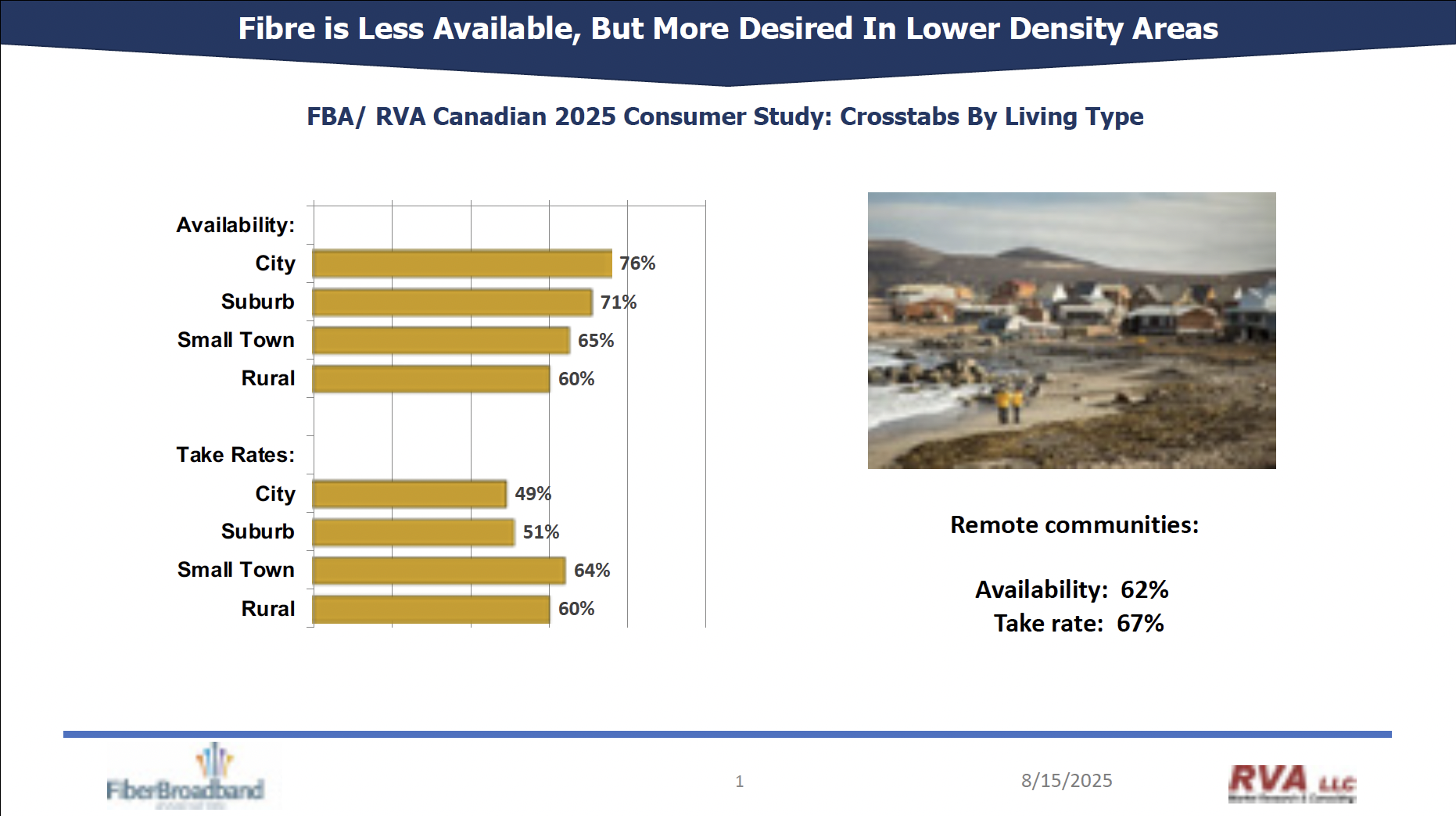
Fiber is less available in lower density areas but is more desired by homeowners living in those areas. FTTH is available in about 76% of cities and 71% of the suburbs, with take rates of 49% in cities and 51% in the suburbs, while small town availability is at 65% and rural at 60%, but small towns have a 64% take rate and rural areas have 60% take rate.
“You can see that availability goes down as you get to rural areas, but take rates actually go up,” said Render. “People in more rural communities do want the fiber.”
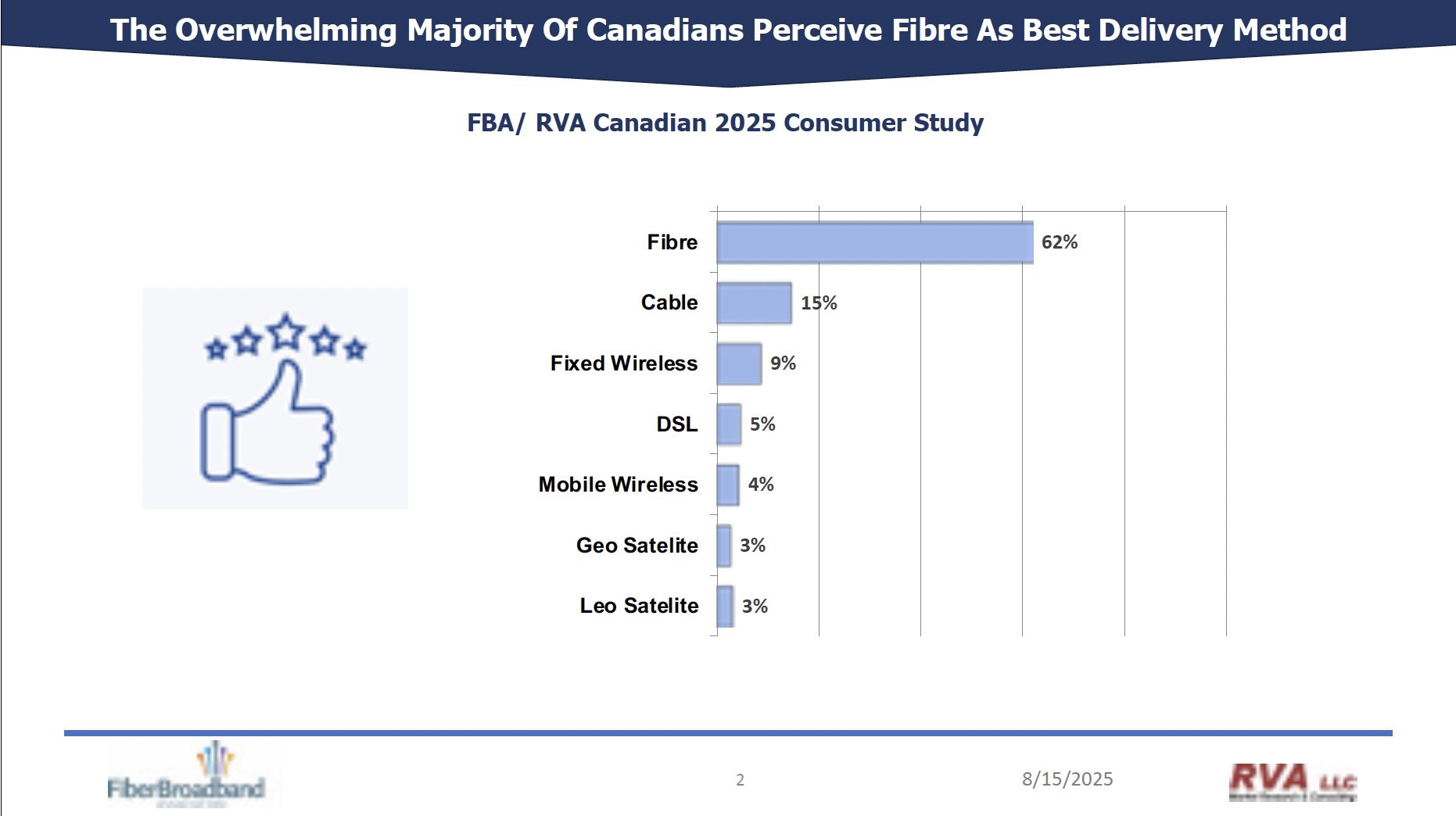
The overwhelming majority of Canadians perceive fiber as the best delivery method for broadband, with 62% viewing it as more desirable than cable (15%), fixed wireless (9%) or other options such as DSL, mobile wireless, or satellite.
RVA’s survey explored the performance of existing Canadian broadband options based on speed tests taken during the surveys, reviewing download, upload, and average speeds along with the median latency. Fiber came out on top by a substantial margin, delivering the top numbers even when taking into account that speed tests in many cases were run through Wi-Fi connections that may have slowed speeds and reduced latency.
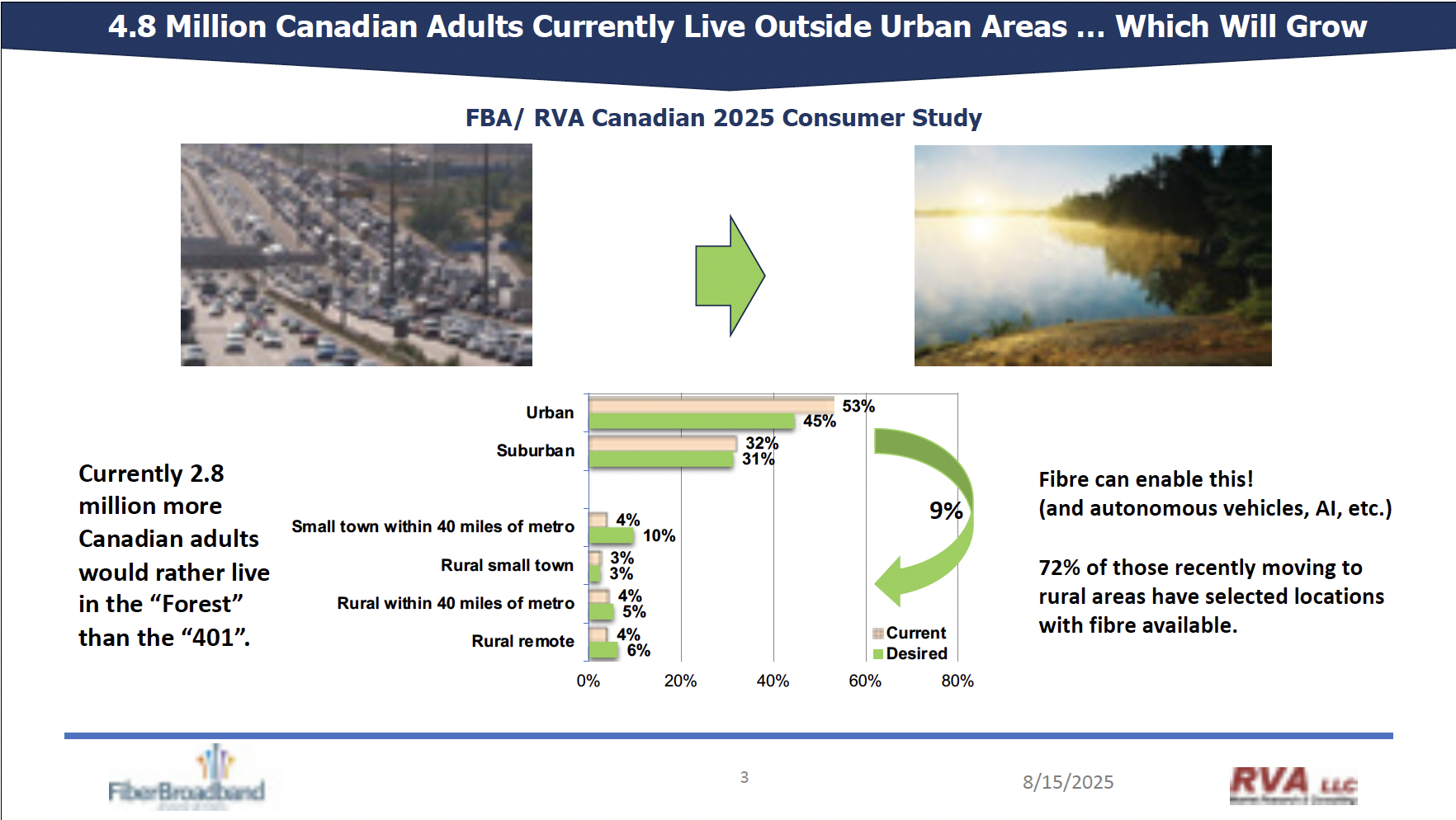
Extending fiber to unserved areas of Canada presents both challenges and opportunities. The country’s higher population density means that 75% of the people already have access to fiber, but the 25% that live in more rural areas will be much more difficult to reach due to distance, geography, and weather. Around 4.8 million Canadian adults currently live outside of urban areas, a number that is expected to grow in the years to come. Another 2.8 million Canadians would like to move from urban and suburban areas into more rural areas, Render noted, with fiber enabling that migration. For those who have recently moved into rural areas, 72% selected locations that had fiber available.
What Canadians Do with Fiber
Canadians selecting fiber for their homes are using it in many ways, including work from home (WFH) or work from anywhere (WFA), online education, and telehealth visits. RVA survey data shows that anywhere from 42% (Rural) to 58% (Urban) of Canadians have a job that can be performed from home, with the expectation that small town and rural sectors will get more WFA jobs over time.
But the results became more interesting as it delved into who is actually taking advantage of WFA. Of those who can work from home, 78% of urban residents do so, 86% of suburbanites, a whopping 95% of small town residents who have the option, and 75% of rural residents.
Internet access is critical for Canadian home-based businesses, which generate significant amounts of income for their owners, rather than being a simple side gig, with the median income from such businesses around $20,000 with the average around $34,000.
“More people in rural areas have home-based businesses than in urban areas,” said Render. “These include things like self-created goods, reselling goods obtained from others, and services completed online. And for services offline, such as being a plumber, you’re still heavily reliant on the internet for things like marketing, electronic payments, and part ordering.”
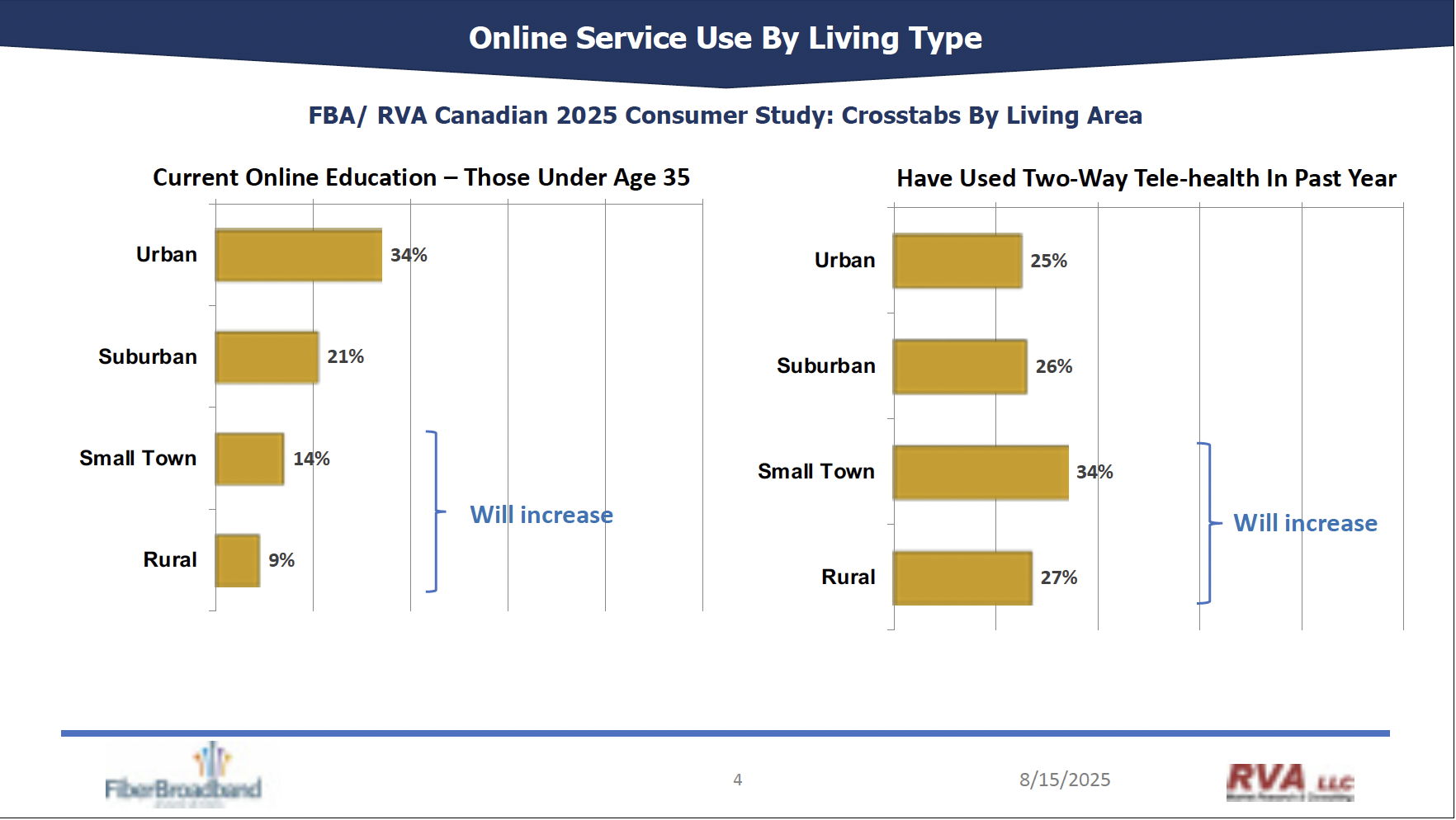
Assessing who uses online education under the age of 35, Render found that 34% of urban residents do so, 21% suburban, 14% small town, and 9% of rural residents, with the expectation that small town and rural usage will increase as more younger people move to rural areas and online familiarity continues to improve.
Two-way telehealth usage over the past year seems to be roughly proportional to local access to health care resources, with 25% of urban residents using it, 26% of suburbanites, 34% of small town residents, and 27% of rural ones, with RVA expecting the usage of telehealth to increase in small town and rural areas.
Canada’s Desire for Reliable Internet
When Canadians switch to a new internet provider, the top three reasons they cite for switching are better reliability and service uptime (70%), better download speed (64%), and more reliable internet access in an emergency (62%).
“When we list different messages, reliability is a big one that people say is a reason for them to switch,” said Render. “If you start to cross-tabulate by different demographics, there are differences. Older people are especially concerned about reliability and lower service interruptions. Younger people are concerned about gaming. You can target a marketing message based upon the community and different demographics of the community.”
Render sees considerable upside for Canadian fiber in the future. With the need for more data centers, Canadian locations provide advantages in cooling and, in some areas, access to lower cost power, driving middle mile growth.
“You’ve got fiber to the [cellular] tower,” said Render. “In Canada, you have long highways and railroads and so forth that need to be covered. Fiber to the area, fiber to the grid. Almost everything, whether it’s solar, wind, or fossil fuels, is using fiber to monitor and control generation and distribution. With windmills, you can’t use electrical or radio, because of the interference issues, it has to be fiber going up the structure.”
Other areas for growth include using network fiber as a sensor to monitor environmental conditions such as seismic activity to detect earthquakes, construction activities that could disrupt services, and heat that could affect power distribution lines. Quantum computing, fiber to the room for homes, offices, and MDUs, and fiber within vehicles are expected to keep the need for fiber and fiber technicians strong for many years beyond the maturity of the FTTH boom.

Related Content
For tribal nations, sovereignty and the preservation of indigenous cultures is fundamentally intertwined with the scrutiny, acceptance, and adoption of the latest technologies. This path provides a sustainable bridge between generations while creating jobs and strengthening ownership and self-governance.
Alabama-based Dragonfly Internet is a relatively new service provider but traces back its leadership and experience roots to owner ITC Holding Company, LLC, a venture and management firm with decades of involvement in wireline, cellular, and internet service providers.
EPB started installing the first parts of its smart grid in 2009, leveraging an investment in fiber optics to ultimately connect 1,200 automated switches across its electrical plant along with over 200,000 smart meters across its 600 square-mile Chattanooga, Tennessee, service area. In its 15 years of operations, the smart grid delivered considerable benefits to EPB customers, including a 50-60% annual decrease in outage minutes that translated to up to $55 million in savings per year by helping them avoid spoilage of food, lost productivity due to the shutdown of equipment and ecommerce, and other negative impacts.