
Fiber for Breakfast Week 20: Delivering the Nighttime Sky with Fiber

Fiber for Breakfast Week 20: Delivering the Nighttime Sky with Fiber
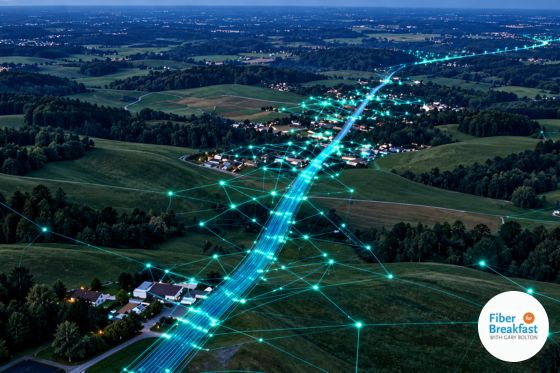
Most conversations about broadband focus on speed, access, or economic development. This week’s Fiber for Breakfast took a different direction entirely — looking upward instead of outward. Far from the urban centers of Dallas and Austin, in the dark skies of rural Coleman County, Texas, fiber infrastructure is quietly powering something unexpected: a global observatory network connecting thousands of people to space.
In a conversation with Josh Kim, co-founder of Starfront Observatories, live from Fiber Connect 2026 in Orlando, Gary explored how one of the most remote places in Texas became a destination for astronomers, educators, hobbyists, and researchers around the world. The premise sounds almost improbable at first: hundreds of telescopes operating remotely from a tiny rural community with fewer than 8,000 residents spread across nearly 1,300 square miles. But the combination of dark skies, dry weather, and robust fiber connectivity created exactly the environment Starfront needed.
“Fiber lights the way to the Milky Way and beyond” wasn’t just the theme of the episode — it was the operating model.
The company’s facility now spans 14 observatory buildings housing more than 800 telescope systems, with roughly one new building added every month. Every clear night, the roofs roll open automatically and customers from around the world log in remotely to control their telescopes, capture images, and collect astronomical data. Some are hobbyists. Others are schools, universities, researchers, and commercial customers tracking satellites and space activity.
What emerged throughout the conversation was that Starfront is not simply building observatories; it is lowering the barriers to experiencing space itself. For decades, serious astronomy required expensive equipment, technical expertise, and access to ideal viewing conditions. Starfront’s model changes that equation. Some of the company’s smart telescopes are no larger than a shoebox, can be controlled directly from a phone, and allow customers to collect high-quality astronomical data from one of the darkest places in the country. “The barriers are coming down to explore space,” Kim explained.
But none of it works without fiber. Every telescope system is connected through dedicated fiber infrastructure supporting automation, imaging, remote access, and the transfer of enormous amounts of data generated during long exposure imaging sessions. As Gary asked during the discussion, how would this work without fiber? Kim’s answer was simple: “It wouldn’t.”
The episode ultimately became about more than astronomy. It was about what happens when world-class connectivity reaches rural communities and enables entirely new experiences, industries, and forms of participation. In Coleman County, fiber is not just connecting people to the internet — it is connecting them to the universe.
Click here to watch the full interview.

Related Content

Fiber for Breakfast Week 40: Telecom Turning Point: Connecting America and Building What Comes Next After years of planning, approvals,…
Fiber for Breakfast Week 40: Arkansas’s Broadband Momentum Arkansas entered this decade with a lot of broadband work left to…

WASHINGTON, D.C.— (October 7, 2026)— The Fiber Broadband Association (FBA) today announced that its Fiber for Breakfast series will celebrate its…