
Unlocking Quantum Networking, One Qubit at a Time

Unlocking Quantum Networking, One Qubit at a Time
Mastering the complexities of quantum to move it from lab bench to commercial deployment is not for the faint-hearted, but everyone from determined startups to telecommunications equipment manufacturers and Tier 1 service providers are working to develop the building blocks for real world use. Companies have been able to build stand-alone quantum sensors and quantum computers, but connecting and networking them together, especially at long distances, is a challenge that is just now starting to show steady progress.
One of the building blocks of the quantum world is single photons, called qubits. Telco-grade fiber and electronics have proven to be the ideal medium for moving qubits from point to point, a necessary step in implementing quantum key distribution (QKD) for moving security to the next-level when production quantum computers emerge to make existing encryption schemes vulnerable.
Quantum computers, sensors, and QKD all need quantum networking for practical applications at scale. Building a cloud of quantum computers within and outside of the data center, connecting large numbers of quantum sensors, distributing qubit-keys in a point-to-multiple fashion and moving beyond the repeater limit of point-to-point fiber all require quantum networking.
The basic problem holding up scalable quantum networks is building a quantum repeater so all the quantum information carried by a qubit can be moved to where it is needed. In a classic network, as photons lose signal between 50 to 100 kilometers, repeaters amplify the signal along the route, while switches and routers move direct data along different paths in the network. Hollow-core fiber can extend that distance a bit, but sooner or later, you need to touch and duplicate photons.
Under the rules of quantum physics, you can’t simply clone qubits without losing their properties, unlike the way regular photons are handled. Fortunately, there are ways to leverage other quantum physics principles to move qubits along multiple hops and longer distances to enable quantum networks.
Qunnect, a 25-person startup based in New York City, has been working with Cisco and Deutsche Telekom to demonstrate how existing telecom fiber can be used with commercial hardware for building and scaling a true quantum network.
“If you have two quantum devices, like two quantum computers, and you would like to connect them, you need to establish entanglement that is shared between them,” Noel Goddard, CEO, Qunnect. “One of the protocols for doing this is what’s called entanglement swapping. It allows you to interact pairs of entangled photons who never previously met, in order to effectively share entanglement over the pairs.”
In New York City, Cisco and Qunnect demonstrated how to do entanglement swapping using regular deployed telco-grade fiber with Cisco’s quantum network software stack on Qunnect hardware, moving information along three different nodes separated by 18 kilometers of fiber running under the busy streets of the city between the Brooklyn Navy Yard and a data center located at the legendary 60 Hudson Street, one of the major telecommunication exchanges of the world.
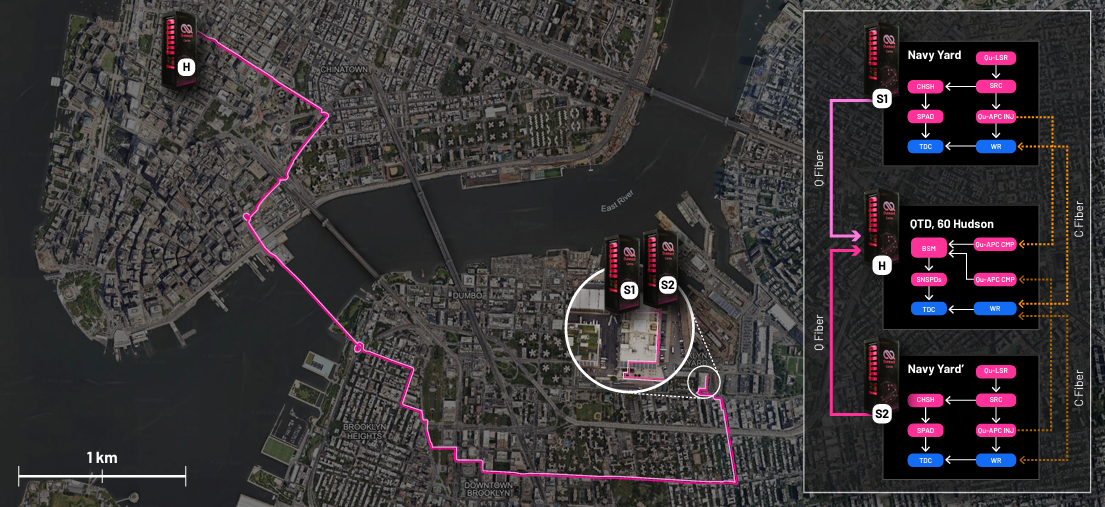
Cisco and Qunnect successfully moved entangled qubits on telco-grade fiber through the heart of New York City to and from 60 Hudson Street. Source: Qunnect
The work showed how a scalable hub-and-spoke quantum network could be built using existing field-deployable telco technologies without requiring elaborate cryogenic cooling gear, while operating on what Qunnect’s co-founder described as “some of the noisiest, most chaotic fiber on Earth.”
In 2023, Brad Lackey, Microsoft’s Senior Principal Quantum Architect, cited the ability to link together multiple sites through entanglement as “Stage 2” out of three stages on the road to a true quantum internet. The significance of connecting multiple sites at the quantum level using commercial hardware and in-service fiber cannot be understated, since it means service providers have a practical path to implementing quantum communications.
Establishing quantum entanglement enables the use of quantum teleportation, being able to move the information encoded in qubits by a quantum device to different locations. Deutsche Telekom (DT) demonstrated quantum teleportation on its in-service fiber in Berlin, showing that it could be done in parallel with classic data traffic and telco hardware.
“Our first demonstration with Deutsche Telekom six months ago was to show they could broadcast entanglement over their network using a number of different paths between two destinations,” said Goddard. “The equipment on our rack was able to correct for any disruptions within the network itself to maintain the quality of entanglement. And [DT] showed that they could switch between the different pathways on the network while maintaining the same high fidelity.”
Entanglement information was broadcast over the O-band while digital data traffic was broadcast on the O-band, with distances as long as 100 kilometers of DT’s Berlin production fiber for weeks at a time with very high-performance metrics.
As quantum computers and sensors move into general use, entanglement and teleportation will be the means those devices exchange information over fiber within the walls of quantum data centers and by larger scale networks connecting quantum devices and facilities over larger distances. “We always think of data centers as effectively being a compressed version of a larger city network,” said Goddard. “All of that requires not only the ability to generate and to distribute high-quality entanglement, but also to be able to control them.”
But there’s still more work to be done to get to quantum networking, including a way to interconnect quantum devices, such as computers and sensors which rely on exotic technologies such as cryogenic cooling and doped diamonds, with the more mundane world of fiber optics able to operate at room temperature.
While that work is going on, Deutsche Telecom and others are examining how to turn quantum entanglement into a service, with enhanced security for a near-term offering. “Use cases are things that actually drive deployment. There are several applications we’ve been working on,” said Goddard. “One of them is the ability to create a quantum alarm system, where you can identify eavesdropper presence. Another one is using quantum to be able to triangulate the position of an entity you’re transacting with, that’s useful for financial transactions and critical infrastructure.”
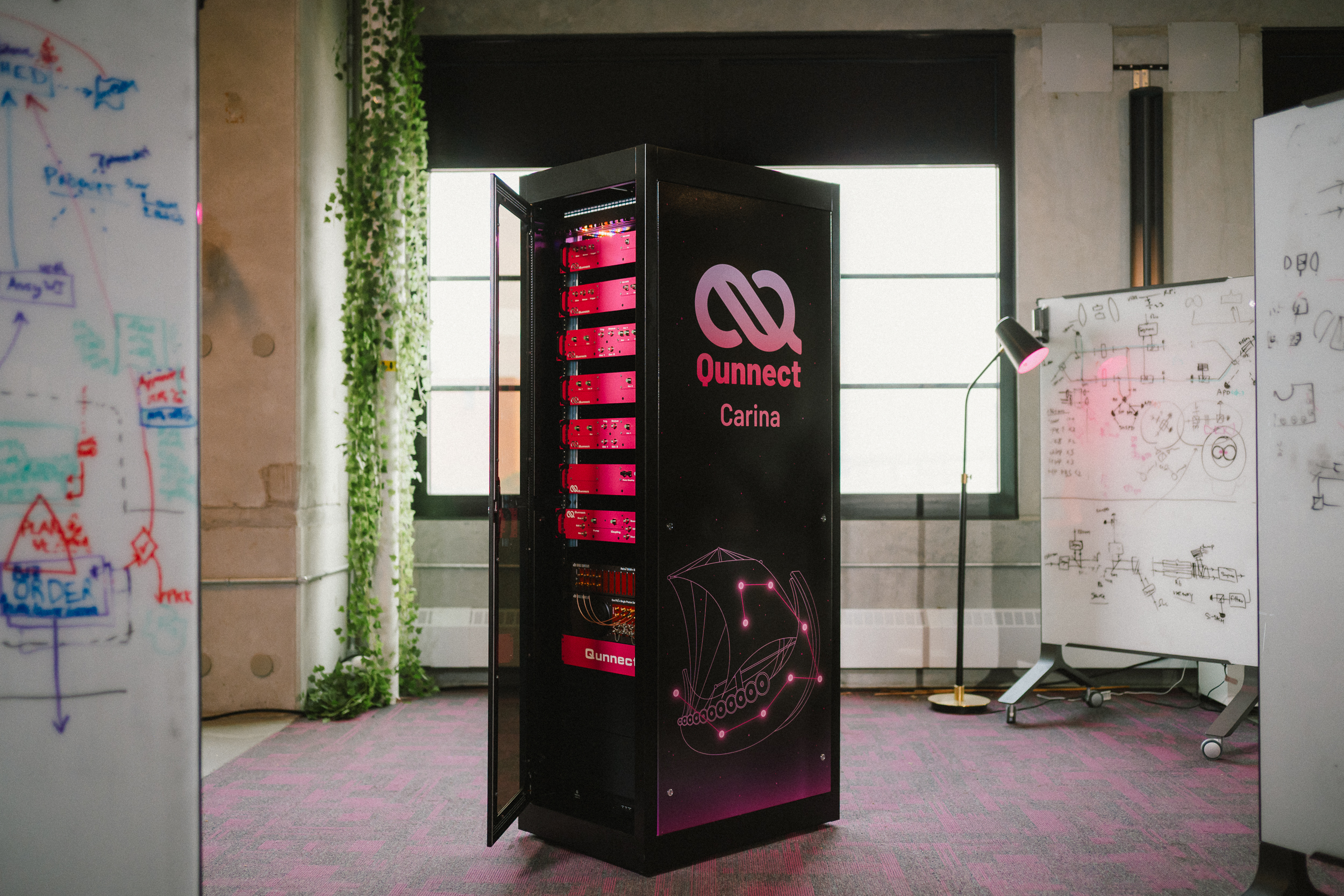
Equipment for quantum networking is large and expensive, such as Qunnect’s Carina, which lists at $1 million and takes up a full rack of space. Source: Qunnect
More use cases will be necessary to drive a virtuous cycle that will drive miniaturization and the cost of quantum network equipment. Qunnect’s Carina hardware currently takes up a full equipment rack and lists prices in the neighborhood of $1 million per node. Ramping up production will require investment and customers purchasing gear at scale for deployment within data centers and metro and larger networks.
But the time is quickly coming where quantum hardware won’t be a novelty, but a necessity. “Security is something that we can never have enough of,” said Goddard. “It’s no longer a question of whether [industry-standard] RSA [encryption] is going to be broken, it’s a question of when. Security will be the application that drives the investment to get the cost of this equipment down to something that’s routine.”

Related Content

Huntsville, Alabama, USA. October 8, 2026. Adtran today launched Mosaic One Agents, a suite of AI agents designed to help…

South Carolina, 24/September/2026: (“STL”) [NSE: STLTECH], a leading connectivity solutions provider for AI-ready digital infrastructure, has strengthened its Neuralis Data…

Fiber for Breakfast Week 38: 30 Years of Broadband: What We’ve Built, What We’ve Learned, and What Comes Next Thirty years ago, broadband looked quite…