Regional Data Centers Continue Middle Mile Investments


Regional Data Centers Continue Middle Mile Investments
One of the ill-kept secrets of the data center world is the expanding construction and ownership of fiber to connect geographic sites. While building fiber miles is more expensive up front, owning a long-term asset with distinct control of the operating environment and costs for 30 or more years is a significant advantage, while also providing the opportunity for additional revenue through leasing dark and lit fiber to third parties.
Michigan-based US Signal is among the data center operators steadily investing in fiber infrastructure in response to AI demands. In February 2026, it announced it is in the process of building over 1,000 miles of new middle-mile network infrastructure across Ohio and Indiana, including high-density fiber and multi-conduit systems. To date, approximately 30% of the network has been completed with the remaining routes anticipated to be finished by the beginning of 2027.
“US Signal’s journey over the past 25 years has been one of deliberate evolution,” said John White, Chief Operations Officer of US Signal. “We started as an enterprise ISP, then strategically expanded into data centers and cloud to meet the growing infrastructure demands of our customers. Today, we’re extending that strategy by building next-generation fiber infrastructure, very different from the 9,500 route miles we originally operated. This next generation fiber is designed to support high-performance, cloud and AI-driven workloads across the Midwest and beyond.”

US Signal is investing in high-density middle-mile fiber and conduit to support high-performance AI and cloud workloads, says COO John White. Source: US Signal
US Signal’s recent growth has been fueled by its 2023 acquisition by Igneo Infrastructure Partners, a long-term infrastructure investor, followed by US Signal’s acquisition of OneNeck IT Solutions in 2024. These moves significantly expanded both its data center footprint and geographic reach. Today, US Signal operates 17 data centers, extending as far west as Bend, Oregon; Denver, Colorado; and Phoenix, Arizona. At the same time, US Signal is evolving its network to meet new demand, moving beyond legacy builds of 192 to “400-plus” fiber strands toward next-generation infrastructure. This includes more robust, high-capacity fiber deployments across the next 100+ miles, purpose-built to support hyperscale and AI-driven workloads.
“People underestimate how much fiber you’re going to need,” said White. “The fiber infrastructure we’re building now is four conduits with four microducts in each, with the ability to put 864 strands in each of the microducts,” said White. “It’s a completely different, apples and oranges style of fiber network than we had in the past. When you think about AI inferencing, dealing with latency, and a high-bandwidth future, that’s what we’re focusing on doing right now.”
US Signal is looking at the next step in density, upgrading to 1,728-strand cable, both for satisfying existing demand and futureproofing for tomorrow. Having open conducts and micro ducts provides flexibility to deploy denser cable as needed based upon customer demand, as well as the option to deploy hollow core fiber when it becomes available.
But there’s additional opportunities from owning the entire network infrastructure beyond simply having conduit for expansion and being able to lease fiber.
“One of the interesting things we’re doing that is very different from most of our competitors is that we’re building the ILAs (Inline Amplifiers) as well as the fiber,” said White. “We’re getting questions on how to put a server in those places so they can reduce latency in data acquisition, and handle processing for AI.. When we’re building the ILAs, we’re buying multiple acres of land on that plot, bringing in three phase power, large generators and we’ve designed them like an RV park-style ILA hut farm.”
The US Signal ILAs are premanufactured structures that can be configured as Tier 3 rated data centers with N plus 1 redundancy, including cooling and power, making them ideal to be dedicated to a specific client or shared among several customers as needed.
With over 1,400 enterprise customers, the firm works with enterprises, carriers, hyperscalers, and managed service providers (MSPs) that need cloud facilities but don’t want to operate their own data centers. US Signal’s publicly disclosed customers include the City of Minneapolis, various healthcare organizations, Rockford Mutual Insurance Company, Ross Medical Education, and Trek Bicycle.
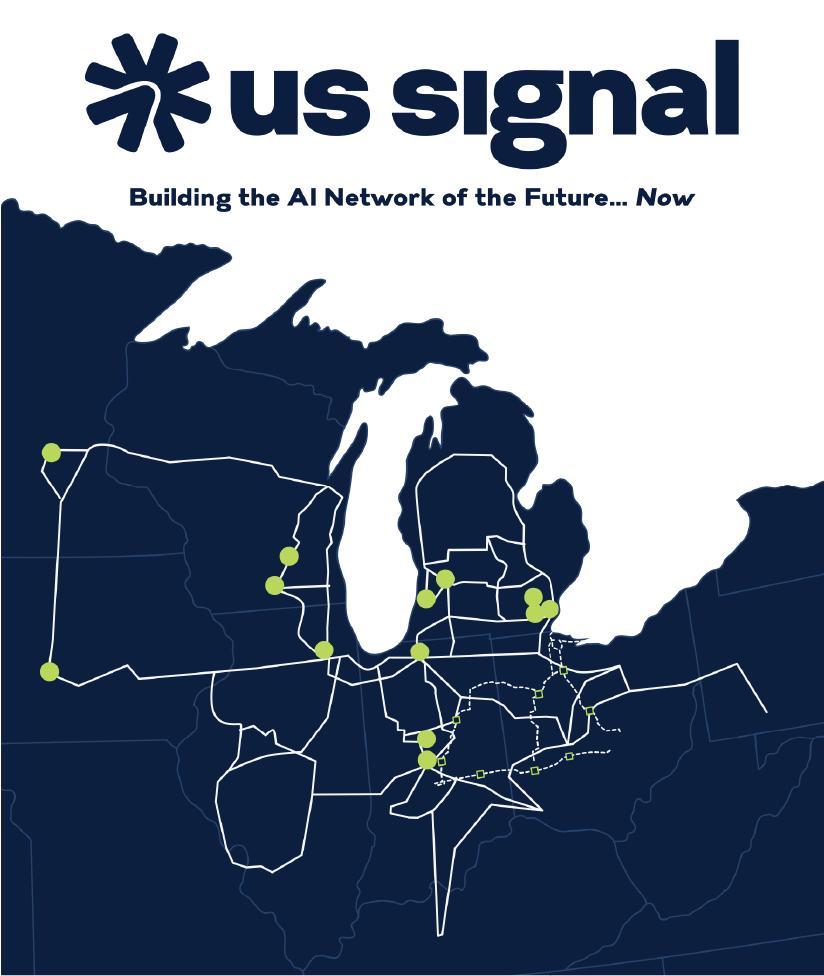
Michigan-based US Signal is installing over 1,000 miles of new middle-mile network infrastructure across Ohio and Indiana. Source: US Signal
“When you think about where the puck is going with distributed applications, we think about inference and how consumers are going to interact with AI,” said White. “Businesses need to have the full stack, the connectivity, the data center, and the cloud to be able to run applications. If you run a healthcare business today, if everything is in the cloud now, that’s fine, but you can’t sit and wait for specialists to upload their videos, their imagery. You need something closer and faster to where the data is generated. So, you’re going to need the combination of cloud, data center, and fiber.”
White sees the combination of data center and fiber that US Signal offers as unique and will become much more valuable in the future. Igneo Infrastructure Partners, US Signal’s investors, aren’t looking for a return on investment within a set period of time, but are taking a long-term view, said White, and he expects further growth to come through a combination of organic growth and investment along with strategic acquisitions.
“We’re going to have yottabytes of data being generated and stored in data centers all over the world,” said White. “How many places can you connect without having to go through multiple hops or internet exchanges to access that information? One thing we’re trying to do is stitch together Tier 1, Tier 2, Tier 3 cities to create a network of repositories to provide that data. If you only have one element of the cloud/data center/fiber mix, then you have to talk to two other partners. Putting all three together under one roof is a huge value proposition long term.”

Related Content
Fiber for Breakfast Week 42: From Classical to Quantum: An Infrastructure Roadmap for Fiber Operators Quantum networking can sound like…

SAN DIEGO, Oct. 14, 2026 — HNM Systems today announced the formal launch of its dedicated Data Center Practice, consolidating…
Huntsville, Alabama, USA. October 8, 2026. Adtran today launched Mosaic One Agents, a suite of AI agents designed to help…