Make the most of FBA membership – or learn how to join.
Contact us at membership@fiberbroadband.org.
Powering the Network (Out & About)
FBA Brings AI and Fiber Discussion to Capitol Hill
FBA recently hosted a bipartisan Capitol Hill briefing – Connecting the AI Future – convening congressional staff, policymakers, industry leaders, and broadband advocates for a discussion on the future of artificial intelligence and the fiber infrastructure needed to support it.
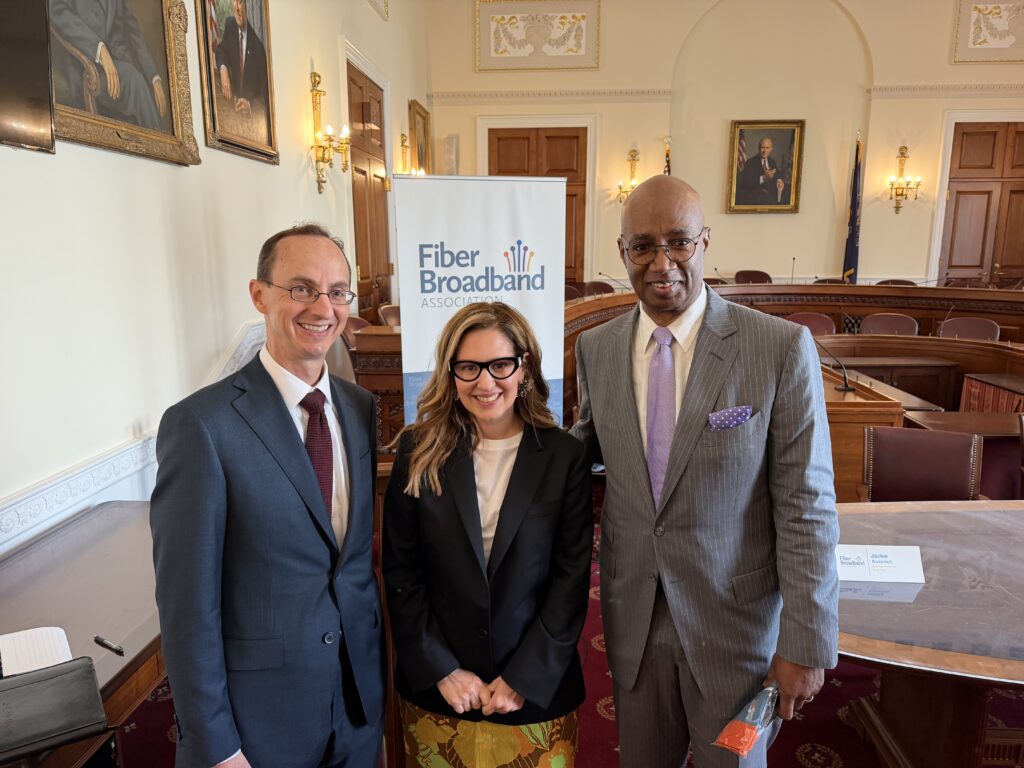
From left to right, Joe Cavender, Lumen technologies, Marissa Mitrovich, FBA, and Larry Irving, Irving Group
Moderated by Jackie Kucinich, Washington Bureau Chief of The Boston Globe, the conversation explored how workforce development, broadband deployment, federal investment, affordability, and programs like BEAD will shape America’s ability to lead in an increasingly AI-driven economy. Opening remarks were provided by Rep. Jennifer McClellan (D-VA) and Rep. Julie Fedorchak (R-ND).
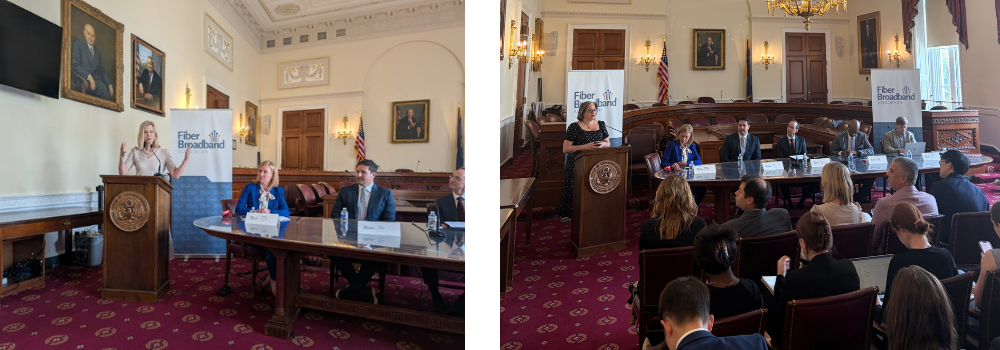
Left image – Rep. Julie Fedorchak (R-ND); Right image – Rep. Jennifer McClellan (D-VA)
The discussion reinforced a central theme echoed throughout the event: fiber is the foundation of the AI economy. As demand for data-intensive applications continues to grow, scalable and reliable fiber infrastructure will be essential to supporting innovation, economic competitiveness, and the next generation of connected technologies.
Industry Partners Gather for Annual Summer Reception
FBA was proud to once again partner with NTCA–The Rural Broadband Association, Wireless Infrastructure Association (WIA), and Telecommunications Industry Association (TIA) to host the annual Summer Reception in Washington, D.C.
The event brought together policymakers, industry leaders, association members, and broadband stakeholders for an evening of networking and conversation at a pivotal time for communications policy. The strong turnout reflected the value of collaboration across the broadband ecosystem and the shared commitment to advancing connectivity nationwide.
FBA extends its appreciation to our partner associations for their continued partnership and leadership. Together, we are helping foster the relationships and dialogue necessary to support the policies, investments, and innovation that will power the networks of the future.
FBA Applauds FCC Action on Broadband Deployment Barriers
FBA welcomes Chairman Carr and the FCC’s Notice of Proposed Rulemaking (NPRM) on Section 253, which seeks comment on state and local policies that may impede broadband deployment. Adopted on June 25, at the June 2026 Open Commission Meeting, the proceeding examines issues including permitting delays, excessive fees, in-kind contribution requirements, and other practices that can increase costs and slow the deployment of broadband infrastructure. FBA has long advocated for reforms that improve the efficiency, predictability, and transparency of the permitting process, particularly as providers work to connect communities through historic investments such as BEAD.
FBA Submits Reply Comments on Communications Marketplace Report
On June 22, FBA submitted reply comments in the FCC’s Communications Marketplace Report proceeding, continuing its advocacy for policies that support investment, competition, and broadband deployment.
In its filing, FBA highlighted the continued growth of fiber broadband deployment and the increasingly competitive communications landscape, while emphasizing the importance of policies that remove barriers to infrastructure investment and accelerate network expansion. The Association also reinforced the critical role fiber plays in supporting emerging technologies, economic growth, and America’s long-term competitiveness.
The Communications Marketplace Report is prepared by the FCC for Congress and serves as a key assessment of competition, market trends, and regulatory issues across the communications sector.
FBA Releases White Paper on Fiber and the AI Economy
FBA released a new white paper, Building the Nervous System of a Thinking Economy, in which President and CEO Gary Bolton explores how fiber broadband and artificial intelligence are converging into a single, strategic infrastructure ecosystem.
The paper argues that fiber is no longer simply the foundation for broadband – it is becoming the infrastructure through which intelligence moves. As AI adoption accelerates, resilient, high-capacity fiber networks will be essential to powering data centers, edge computing, real-time applications, and the next generation of economic growth.
Read the full white paper here.
Light Byte: Trend of the Month
The World Cup Runs on Connectivity
As the world turns its attention to the FIFA World Cup, one trend is becoming increasingly clear: fans expect connectivity to be as reliable as the match itself.
Recent research found that nearly two-thirds of fans plan to connect to Wi-Fi, powered by a fiber backbone, while watching matches at public venues, with younger fans even more likely to stay connected throughout the experience. Sharing highlights, checking statistics, posting reactions, and engaging on social media have become part of the modern game-day ritual.
Telecom and broadband providers are treating the tournament as a showcase for network performance, rolling out upgrades, enhanced streaming capabilities, and new tools to manage surging traffic. As one of the most connected sporting events in history unfolds, the World Cup serves as a reminder that every goal, replay, and celebration depends on robust broadband infrastructure – and that fiber remains the foundation powering the world’s biggest moments.
Recent research found that nearly two-thirds of fans plan to connect to Wi-Fi, powered by a fiber backbone, while watching matches at public venues, with younger fans even more likely to stay connected throughout the experience. Sharing highlights, checking statistics, posting reactions, and engaging on social media have become part of the modern game-day ritual.
Telecom and broadband providers are treating the tournament as a showcase for network performance, rolling out upgrades, enhanced streaming capabilities, and new tools to manage surging traffic. As one of the most connected sporting events in history unfolds, the World Cup serves as a reminder that every goal, replay, and celebration depends on robust broadband infrastructure – and that fiber remains the foundation powering the world’s biggest moments.
Policy in the Conduit (Policy & Regulatory Updates)
Lawmakers Press NTIA on Delayed BEAD Non-Deployment Guidance
Rep. April McClain Delaney (D-MD) and several House Democrats are pressing NTIA and the Commerce Department to release long-awaited guidance on how states and territories may use an estimated $21 billion in non-deployment BEAD funding.
In a letter to Commerce Secretary Howard Lutnick and NTIA Administrator Arielle Roth, lawmakers argued that the agency has missed previously stated timelines and urged the Administration to issue guidance by June 22. The lawmakers also called on NTIA to preserve flexibility for eligible uses such as workforce development, telehealth, digital literacy, and cybersecurity.
The latest push reflects growing frustration among stakeholders seeking clarity on how remaining BEAD funds can be deployed as states continue to advance broadband planning and implementation efforts.
Texas Reopens BEAD Awards After Providers Withdraw from 31,000 Locations
Texas is preparing an additional BEAD bidding round after several provisional subgrantees withdrew from projects covering approximately 31,000 broadband service locations, creating new funding opportunities as the state finalizes its deployment plans.
The withdrawals affect roughly 13% of the locations initially included in Texas’s provisional BEAD awards and highlight some of the challenges providers face as they evaluate project economics, deployment obligations, and long-term program requirements.
Despite the changes, Texas remains one of the nation’s most complex BEAD states, having finalized subgrantee agreements expected to connect more than 208,000 unserved and underserved locations. State officials are moving quickly to reassign the affected areas and keep deployment efforts on schedule.
NTIA Launches $790 Million Tribal Broadband Funding Opportunity
On June 17, NTIA announced two new funding opportunities totaling $790 million to expand broadband access and digital infrastructure in Tribal communities across the country.
The funding includes a new round of the Tribal Broadband Connectivity Program and the Native Entities Grant Program, which will support broadband deployment, adoption, and infrastructure projects on Tribal lands. Applications for both programs are due September 17, with awards expected to begin in spring 2027.
OMB Seeks Input on Federal Grant Management Rules
On May 29, the Office of Management and Budget (OMB) issued a request for comment on proposed updates to 2 CFR Part 200, the government-wide regulations that govern the administration of federal grants and cooperative agreements.
The proposed changes could have implications across a range of federal broadband programs, including grant administration, compliance, reporting requirements, and oversight. Stakeholders are encouraged to review the proposal and assess how the revisions may affect broadband funding recipients and future federal investments.
Comments are due July 13. A summary of the proposed changes is available through Benton Institute’s overview of the proposal.
Senate Passes Broadband Mapping Transparency Bill
On June 18, the Senate unanimously passed the Modernization, Accountability and Planning (MAP) for Broadband Funding Act (S. 2585), bipartisan legislation aimed at improving the FCC’s broadband funding map and ensuring federal broadband dollars are deployed as efficiently as possible.
Led by Sen. Deb Fischer (R-NE) and Sen. Catherine Cortez Masto (D-NV), the bill would direct the FCC to examine how its broadband funding map is used and whether updates are needed to improve usability, transparency, and coordination across federal programs. The legislation now awaits consideration in the House.
USF Reform Gains Momentum Across Congress and the FCC
The Universal Service Fund (USF) continues to face growing scrutiny as both Congress and the FCC advance efforts to modernize the decades-old program.
The FCC announced that the USF contribution factor will rise to a record 38.8% in the third quarter of 2026. While the Commission used $125 million in unused funds to reduce the assessment below earlier projections of 42.3%, stakeholders continue to raise concerns about the long-term sustainability of the current funding mechanism. Meanwhile, legal challenges to the contribution system remain active, with the Fifth Circuit expected to hear oral arguments later this summer in a case brought by Consumers’ Research.
At the same time, leaders of the bipartisan, bicameral USF Working Group continue developing recommendations for comprehensive USF reform, while House Communications Subcommittee Chairman Richard Hudson has indicated he plans to release a separate legislative proposal.
Concurrently, the FCC is examining several USF programs through ongoing proceedings, including Lifeline, E-rate, and the High-Cost program. FBA has actively engaged in these efforts by filing reply comments in the Lifeline proceeding and is preparing comments for the High-Cost Notice of Proposed Rulemaking.
Senate Farm Bill
On June 24, the Senate Agriculture Committee released its Farm Bill 2.0 discussion draft. FBA appreciates Chairman John Boozman’s leadership in advancing reauthorization of critical USDA broadband programs. The legislation strengthens efforts to connect rural communities by codifying the USDA ReConnect Program, streamlining application processes, and sustaining federal support for broadband deployment in underserved areas.
FBA is encouraged by these provisions and looks forward to continued work with Congress and USDA to ensure rural broadband policies prioritize scalable, future-ready networks.
You can access FBA’s full statement here.
FCC Advances E-Rate Review and Broadband Deployment Reforms
On June 25, at its June Open Meeting, the FCC launched a broad review of the E-rate program and advanced a new proceeding aimed at addressing permitting and deployment barriers facing wireline broadband infrastructure.
The permitting NPRM seeks comment on ways to streamline approvals and reduce regulatory obstacles that can delay network construction, while the E-rate proceeding will examine whether the program continues to effectively support connectivity for schools and libraries.
The Commission also adopted actions addressing 911 reliability, emergency alerting systems, and submarine cable security, reflecting a continued focus on modernizing communications networks and strengthening critical infrastructure.
Pole Attachment Rules Draw Increased Federal Attention
Pole attachment policy is receiving renewed attention from both NTIA and the FCC as policymakers look to reduce deployment barriers and accelerate broadband construction.
The FCC recently opened a proceeding seeking comment on ways to improve the transparency and effectiveness of state pole attachment rules, citing concerns about inconsistent requirements and processes across jurisdictions. At the same time, NTIA is defending its efforts to apply federal-style pole attachment requirements within the BEAD program, arguing that greater consistency can help streamline broadband deployment.
California Advances Fiber Deployment While Debating Copper Transition
The California Public Utilities Commission (CPUC) approved more than $18 million in broadband grants to expand connectivity across underserved communities, including nearly $14.7 million to support four fiber-to-the-home projects by Plumas-Sierra Telecommunications. The Commission also approved funding for regional broadband consortia, digital literacy initiatives, and device distribution programs, while adopting a $136 million broadband budget for FY2026–27.
At the same time, California continues to debate the future of its legacy copper networks following the FCC’s order streamlining the retirement of copper-based telephone service. While providers argue the changes will accelerate deployment of modern broadband and wireless networks, consumer advocates are urging the CPUC to maintain its Carrier of Last Resort (COLR) protections to preserve public safety and service continuity during the transition.
New York Surpasses 97% Broadband Coverage
New York’s State Public Service Commission reported that more than 97% of addresses statewide now have access to high-speed broadband, according to its fifth annual broadband availability report.
The report found that just 0.3% of locations remain underserved and 2.5% remain unserved, with more than 16,700 additional addresses connected over the past year. The milestone reflects continued progress toward universal broadband access and highlights the impact of sustained public and private investment in broadband infrastructure across the state.
As deployment efforts continue, the remaining unserved locations are increasingly concentrated in the most difficult and costly areas to reach, underscoring the challenges associated with achieving the final stages of universal connectivity.
House Advances Telemedicine Funding Priority for Rural Communities
On June 4, the House approved an amendment to the FY2027 USDA appropriations bill directing the Distance Learning and Telemedicine Grants Program to prioritize applicants located more than 30 miles from a federally qualified health center.
Introduced by Rep. Shomari Figures (D-AL-02), the amendment aims to improve access to telehealth services in some of the nation’s most remote communities, particularly areas with limited access to mental health and substance abuse treatment providers.
The provision was adopted as part of the broader USDA funding package, which includes more than $638 million for rural connectivity programs, including $40 million for ReConnect, underscoring continued congressional interest in expanding broadband-enabled healthcare access in rural America.
Mark Your Calendar
Fiber Day on the Hill Returns
FBA will be in Washington, D.C. for its Advocacy Day and 4th Annual Fiber Day on Capitol Hill, taking place July 15-16, 2026. This two-day event offers a critical opportunity to bring fiber’s story directly to lawmakers and staff, showcasing the industry’s leadership in the national broadband conversation. This year’s message is clear and urgent: fiber is the critical foundation for powering AI and the next wave of emerging technologies. Without it, none of it works.
Fiber Policy Lab Heads to Montana
On July 20, FBA will host its third Fiber Policy Lab of 2026. The conversation, titled, “Community Connections: How Fiber Can Power Local Relationships,” will be a discussion of the benefits of fiber deployment for communities in the region and how FBA members can build positive and productive relationships with local officials and community organizations. Please reach out to Lukas Pietrzak if you are attending the Bozeman RFC and are interested in participating in the Fiber Policy Lab.
We welcome your input.
Meet Your Public Policy Team

Marissa Mitrovich
Vice President, Public Policy

Lukas Pietrzak
Director of Public Policy

Tinae Bluitt
Public Policy Manager

Jeanne Le Delaizir
GFiber Public Policy Fellow