
Building Empire Fiber


Building Empire Fiber
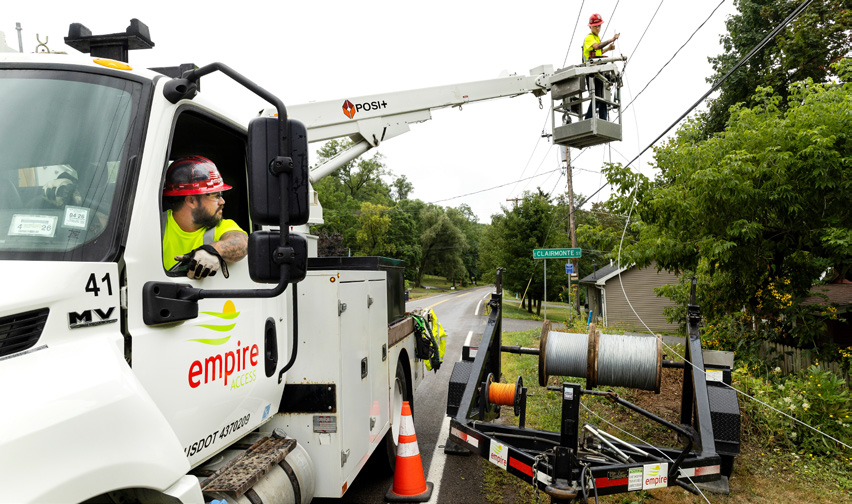
Outside of its major metropolitan centers, the Northeastern United States has steadily become more connected with gigabit-class fiber broadband, as multi-jurisdictional fiber providers have steadily expanded into unserved and underserved municipalities across the states of Pennsylvania and New York. Building on its local roots, Empire Fiber has grown from a family-owned local phone company into a regional provider serving over 100 communities, over 200,000 households passed and employing over 275 team members.
Empire Fiber continues to expand throughout
Pennsylvania and New York. Source: Empire Access
Founded in 1896 in Prattsburgh, New York, as the Prattsburgh Phone Company with a single telephone line, the firm steadily grew throughout the early 1950s through the early 1970s through a series of acquisitions of smaller telephone companies across New York and Pennsylvania, changing its name to Empire Telephone Company in 1980 and Empire Access in 1994.
In the early 2010s, Empire’s owners, the Wagner family, saw the need and opportunity for fiber for internet connectivity. “They started within their own operating territory, initially doing a fiber overlay and expanded that to some of the other markets they owned,” said Kevin Dickens, CEO, Empire Fiber Internet. “In the late teens, 2016, 2017, 2018, they started to edge outside of their operating territory and did a very efficient job, doing most of the work themselves and building some very important internal competencies on the construction side of the business.”
Empire’s combination of building fiber in secondary and rural areas along with the creation of its internal construction resources made it an attractive property. In 2023, Antin Infrastructure Partners purchased Empire and provided it with the financial means to expand much more dramatically with additional capital, rather than simply leveraging its internal cash flow and other resources, such as New York’s ConnectALL Municipal Infrastructure Program funded through U.S. Department of Treasury American Rescue Plan Capital Project Fund (CPF) and USDA ReConnect funding.
“You’re not going to see us in Tier 1, Tier 2 markets,” said Dickens. “Our heritage and what we’re still committed to is bringing fiber services to communities that typically don’t have them. Whether that’s a small rural community or a neighborhood in areas surrounding, say Erie, or Scranton-Wilkes-Barre, Pennsylvania, we’ll build out in those areas that aren’t served by fiber.”
Reaching everyone within rural areas has required a combination of public and private efforts. “As an example, in Livingston County, New York, we have our own private networks we’ve built out over the years in places such as Geneseo and Dansville,” said Dickens. “We’ve partnered with the state to then build out connectivity to virtually every resident of the county, leveraging either the USDA or the ConnectALL program. We’ve assisted with the design and once built, we’re responsible for operations and maintenance of the network, as well as providing services to people in those communities. This rides in parallel with our private projects and we’ve done that in several counties and municipalities across the state.”
Since being acquired by Antin in 2023, Empire has been in what Dickens described as “aggressive build mode” and has added over 100,000 homes passed. “We expect to be doing the same thing as we move forward over the next couple of years,” he said, indicating the company will continue to expand its presence in Pennsylvania and New York as a part of its organic growth.
Empire’s move from phone to fiber provider and a focus on local customer service has brought them a NPS score of 74 and many eager to sign up. “There are stories of people chasing our trucks down the road, wanting to know ‘Are you going down my street and when can I get your service?” stated Dickens.

Related Content

Fiber for Breakfast Week 42: From Classical to Quantum: An Infrastructure Roadmap for Fiber Operators Quantum networking can sound like…

Fiber for Breakfast Week 40: Arkansas’s Broadband Momentum Arkansas entered this decade with a lot of broadband work left to…
For tribal nations, sovereignty and the preservation of indigenous cultures is fundamentally intertwined with the scrutiny, acceptance, and adoption of the latest technologies. This path provides a sustainable bridge between generations while creating jobs and strengthening ownership and self-governance.