
Delivering the Nighttime Sky with Fiber


Delivering the Nighttime Sky with Fiber
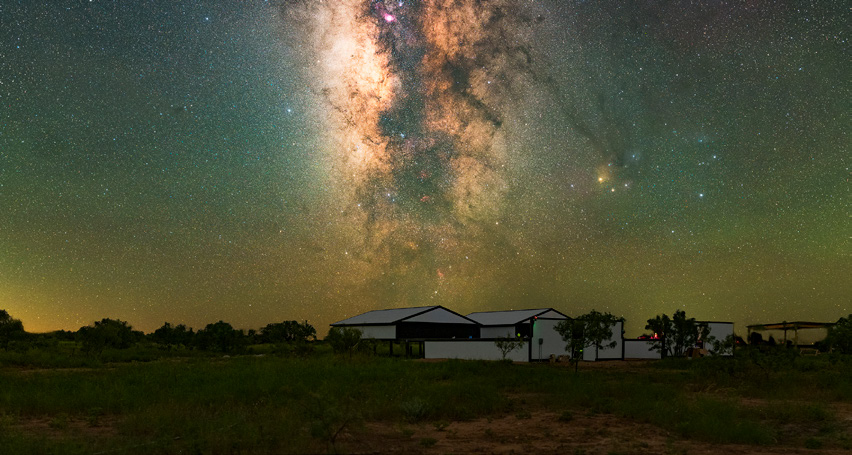
Pristine night skies and rural gigabit fiber enable Starfront to bring the universe to astronomers from around the world. Source: Starfront Observatories
Far away from the urban centers of Dallas and Austin at the northern edge of the Texas Hill Country, Coleman County spans nearly 1,300 square miles with a bit less than 8,000 people, according to the 2024 U.S. Census Bureau estimate. With few people, rural location, and dry weather, the nighttime skies are ideal for year-round astronomy with over 220 clear nights per year.
But how do you bring such a pristine viewing location to hundreds of thousands of hobbyists around the world? Fiber provides the answer.
“We didn’t invent the remote telescope hosting model,” said Josh Kim, one of the co-founders of Starfront Observatories. “Remote hosting has been around for many years. For the most part, it was pursued by well-funded private research initiatives unavailable to the public or amateur astrophotographers who had retired in a rural location and decided they were going to host a handful of telescopes and charge relatively high rent.”
Kim and his cofounders have accumulated deep experience in the astronomy world over many ventures, including most recently building a developer platform for real-time observational data of objects in space, which entailed shipping out telescopes to remote observatories around the world. They experienced firsthand the demand for remote telescope operations for individuals, businesses, and governments, which led them to think about how to build a truly modern telescope hosting operation at scale, one that’s been incredibly successful with the combination of clear skies and fiber.
“There’s more interest in space than ever before,” said Kim. “More people want to look up and see what’s there, but the vast majority of people live under light-flooded conditions that hinder nighttime telescope viewing. Our solution is super simple. You send us your telescope, we install it, we maintain it, we take care of it, and you just access it remotely. You just log in and explore the universe.”
Starfront has seen explosive growth since launching in 2024, with over 630 telescopes installed and operational to date at their Texas location, with additional construction currently underway for additional buildings. Each customer pays a reservation deposit to book a metal “pier” on which the telescope is installed. Once operational, Starfront provides ongoing tech support to ensure smooth remote operation, with a monthly rental fee covering ongoing power, internet, security, and maintenance.
The automated roofs of the observatory buildings are controlled by a proprietary weather monitoring system and open on every clear night and close whenever bad weather is present. The most affordable rental offering is $99 per month for a turnkey smart telescope while their heavy pier is capable of supporting a much larger, professional-grade telescope and costs $399 per month. Larger telescopes (1 meter+ aperture) can be hosted as well on a custom pier upon request.
During the day, the telescopes and the other gear are protected under the cover of a movable roof in the building where they reside. When the sun starts to set, the automated roofs on the buildings roll back on rails and the equipment comes to life, each telescope pointing where its owner wants, often sweeping across the sky in the course of the evening to track planets and stars. At the first rays of dawn, the scopes shut down and the roofs close to end the night of observations.
“Fiber was one of the very, very top priorities that we were considering when we were selecting our site,” said Kim. “We looked all over the country, frankly, all over the world. A lot of factors went into site selection, everything from light conditions to weather patterns to availability of large-scale fiber utilities, those were all important aspects of why we ultimately ended up choosing our Texas location.”
Starfront has attracted passionate customers from around the world, some of whom have gone to great lengths to make sure their equipment is going in the right place. “These telescopes are very valuable and very important to our customers,” said Kim. “Trust is very important and why we’ve built such a truly professional operation. We’ve had a customer from London fly in with his family and his telescope, drop it off, get a 20-minute tour of our facilities, and then leave. It’s almost like sending your kids off to college.”
But Kim was quick to point out that Starfront isn’t open for general visitation. Between continued construction, the need to maintain security and pristine viewing conditions, and local environmental hazards such as scorpions and rattlesnakes, the facility operates like a data center that doesn’t encourage visitors, rather than a tourist attraction.
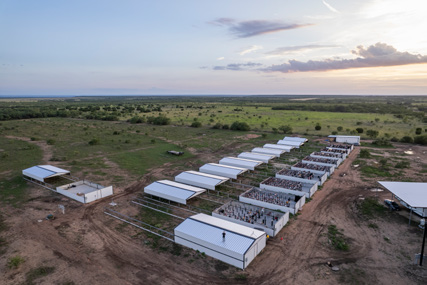
Starfront uses 5 Gbps of fiber broadband to deliver nighttime imagery from 600 hosted telescopes to their owners across the world. Source: Starfront Observatories
The volume and size of data generated every viewing evening is massive, due to the unique amount of observation data generated by a single instrument. “It would be very difficult for satellite internet to service an operation at our scale,” Kim said. “A single telescope can generate upwards of hundreds of gigabytes of imagery each evening,” Kim said, depending on its size and its camera quality, with the information all uploaded and accessible to their customers around the world.
Starfront started its operations with two buildings and a dedicated 1 Gbps fiber circuit with each building set up to host around 60 telescopes on average. Each addition of two buildings also includes an additional dedicated 1 Gbps fiber, enabling the business to scale bandwidth in an incremental fashion. There are also dedicated fiber circuits for the on-site operations team and their needs.
Providing the fiber connectivity that makes Starfront possible is Coleman County Telephone Cooperative. Founded in 1953, Coleman started deploying fiber-to-the-home services in 2019, leveraging support from the Universal Service Fund. The cooperative has deployed 1,053 miles of fiber to date that passes 2,800 locations, with customers able to select from a basic 100 Mbps broadband package for $80/month, 500 Mbps at $100/month, or the “Extreme” package at 1 Gbps at $125/month.
“Our network is capable of providing multi-gig services for any application that demands it; it would just require deploying the appropriate equipment,” said Kandra Young, CEO and General Manager, Coleman County Telephone Cooperative. “We also offer voice services as well.”
Coleman’s network is routed through Abilene and Brownwood, Texas for redundancy, as well as connected to the Texas Lone Star Network (TLSN). While Starfront is its biggest broadband user, other local businesses are embracing fiber to power their businesses as well, including General Leathercraft Manufacturing, which manufactures the Pioneer Fit line of powerlifting belts and accessories, and a Buckstop Truckware production facility that requires high-speed reliable connectivity to the corporate headquarters located in Oregon.
Interestingly, Starfront’s operations have not had a material impact upon Coleman’s network operations due to what they do and when they do it. “They’re operating when everyone else is in bed, asleep,” said Young. “They’re not your traditional eight-to-five [business] customer. Our network is engineered to where we’re prepared for their future growth, and we are able to continue to service them with whatever capacity they need. It’s important to note that without fiber connectivity, they would not be able to operate. Starlink or a WISP would not be able to provide the connectivity they need to thrive.”
While Starfront continues its growth in Coleman’s territory, it is looking much further afield for its next location. “A lot of our customers in the Northern Hemisphere would love to get access to the Southern Hemisphere,” said Kim. “With fiber, we are scaling access to space, enabling more people all over the world to explore the universe with an instant login and find inspiration in its wonders.”

Related Content

Fiber for Breakfast Week 42: From Classical to Quantum: An Infrastructure Roadmap for Fiber Operators Quantum networking can sound like…
Fiber for Breakfast Week 40: Arkansas’s Broadband Momentum Arkansas entered this decade with a lot of broadband work left to…
For tribal nations, sovereignty and the preservation of indigenous cultures is fundamentally intertwined with the scrutiny, acceptance, and adoption of the latest technologies. This path provides a sustainable bridge between generations while creating jobs and strengthening ownership and self-governance.