
Pioneering Robots as a Service in Kansas


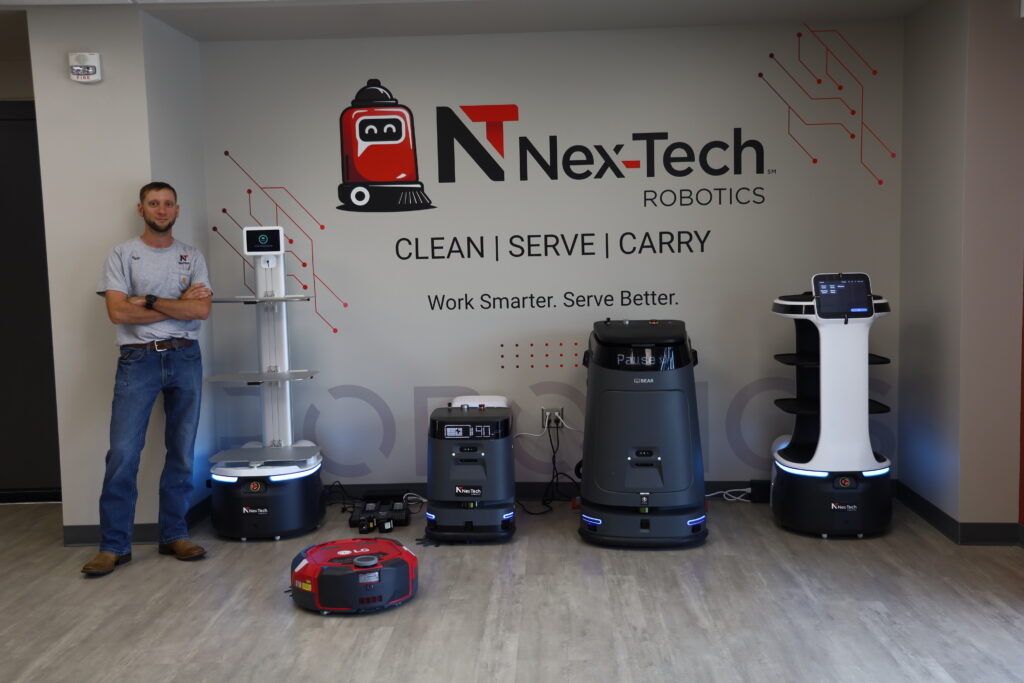
Business-grade robots offer a range of services, from moving things between locations to providing robust-duty-cycle cleaning for large spaces, such as hospitals and recreational facilities. (Source: Nex-Tech)
As service providers expand their portfolios beyond basic broadband connectivity, a select few are moving beyond software-based applications into hardware. Robotics as a Service (RaaS) isn’t a radical leap in imagination for big cities, factory floors, or regional fulfillment centers, but in America’s rural heartland? First impressions can often be wrong, with robotics filling needed gaps regardless of location.
Nex-Tech has been providing technology to homes and businesses in western and central Kansas for decades, so exploring new opportunities that meet the needs of the community is nothing new for the 75-year-old organization. “Our company is, at the core, a cooperative, and our whole existence is providing the services to meet the needs of our community,” said Jimmy Todd, CEO and General Manager of Nex-Tech. “Our communities look to us to bring opportunities to them or meet the needs that they have from a technology perspective.”
Robotics became a topic of interest to the local area prior to COVID, due to extremely low unemployment rates in the area, with businesses and organizations of all sizes in the area having trouble meeting their staffing requirements, from healthcare to small town restaurants struggling to turn over tables quickly enough.
“I sit on a hospital board,” said Todd. “We’re always searching for staff to do the little things. I see the same at nursing homes, the schools. We had a great little restaurant in Hoxie (Kansas) called the Elephant Bistro. It had a high-end menu, people would drive in from out of state, plenty of clientele. But the owner didn’t have enough staff and after a few years she was just burnt out working from morning until after midnight. They closed last year.”
Nex-Tech started making the rounds at various conferences two years ago to learn more about the available market options for business-grade robotics. While numerous Chinese manufacturers offered devices, data collected by the machines would be sent back and stored offshore, raising concerns about usage and privacy. A different choice became available in 2025, when LG Electronics acquired a majority stake in Silicon Valley-based Bear Robotics.
“Bear does not do humanoid robots,” said Shannon Rothchild, Senior Account Manager, Nex-Tech. “They’re all designed for the service industry. They use LIDAR, so they don’t use cameras and aren’t video recording people, places, or things. They’re just using dots on a map to navigate. All the data collected to build the navigation maps, all the other information from their robots is stored at a U.S.-based data center, so there’s a lot of information protection through their approach.”
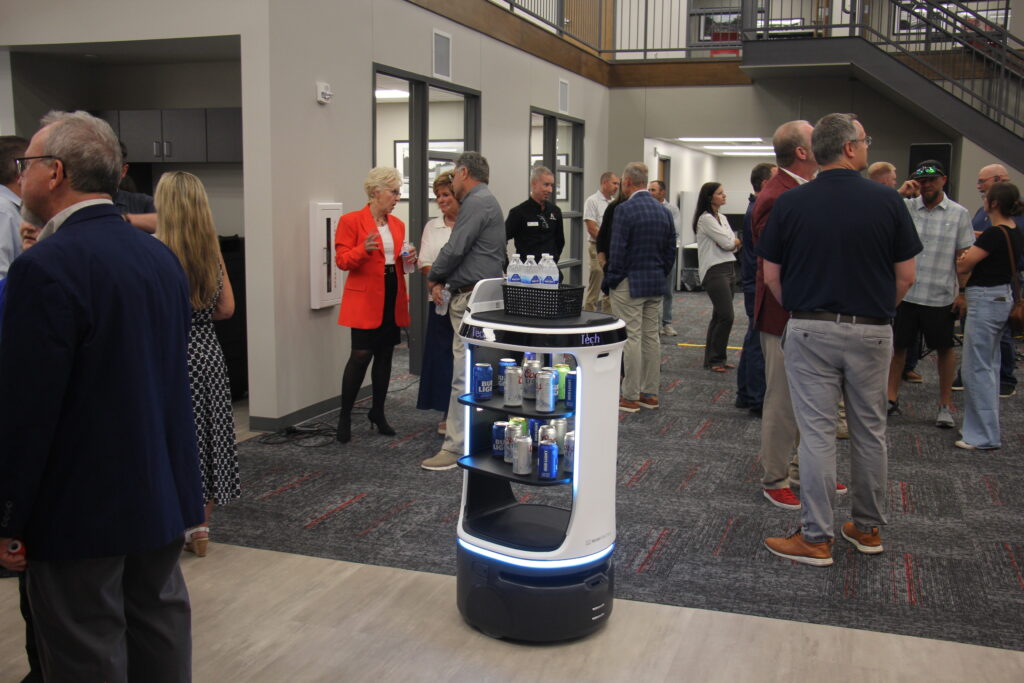
What better way to demonstrate the utility of a robot server than to use it at the soft launch of your new service? (Source: Nex-Tech)
Bear’s robots are designed for the hospitality and service industries to perform basic tasks such as cleaning floors and carrying items, simple chores that a machine can perform as well as or better than a human. Nex-Tech is providing a proof-of-concept trial to interested businesses, bringing out a robot to a use location, configuring and setting it up for service, training staff how to use it, and then putting it through its paces for a month. If the business doesn’t like it, the business covers the cost of configuration and shipping it back to Nex-Tech.
If they choose to keep it, there’s no cost for the trial and the arrangement rolls into a three-year agreement that includes maintenance, parts, and labor, with options for either the business to manage the device, Nex-Tech to manage the device, or co-management. Customers can also choose to buy the robot up front as a capital expense and maintain it themselves, buying and replacing the parts that wear out over time, depending upon what operational model works for their business.
Bringing robots into Nex-Tech’s portfolio opens challenges and opportunities for the company. “Nex-Tech is not a cleaning company, what are we doing?” said Rothchild. “We are a technology company, and we are working under the auspices that technology is going to change, and robotics are going to be a piece of that.”
Rothchild is working with a number of different industries that Nex-Tech hasn’t been involved with before who have needs for this type of equipment, including the education sector from K-12 through universities, larger health care firms such as hospitals and nursing homes, hotels, warehouses, manufacturing, and even car dealerships.
“We’re not out here to replace people; we’re here to make people more efficient. I’ve been to a couple vehicle service departments where the service bays are a long way from the parts counter,” said Rothchild. “Employees spend significant time walking back and forth between the two. They can get a carry bot and save those guys steps, making them more efficient.”
Nex-Tech started a soft launch of the robotics offering in mid-June 2026 with a good deal of initial interest coming from businesses and organizations that have large floors that need to be regularly cleaned, with a more formal launch taking place on August 1, 2026. As of public close in July, multiple customers had signed up for proof-of-concept trials, including a YMCA, hospital, and car dealership, with other local businesses expressing interest as well.
Finding the right RaaS price point is still a work in progress as it refines its operations. Nex-Tech anticipates it may charge anywhere from $500 to $1,500 per month per robot, depending on the number of robots and what they do, with simple vacuuming being much less complicated than the wear and maintenance on a top-end cleaning model designed to clean gym floors and large hallways that weighs 600 pounds empty, holds eight gallons of water to mop and has a squeegee function to help dry the floor.
As mentioned earlier, each robot compiles LIDAR maps of where it operates, with data stored in the cloud using continuous network connectivity through Wi-Fi and the institution’s broadband providing onboard navigation information, and logging of where and what the robot is doing at any moment. There’s a proactive “Come fix me” alert function if the robot has an issue, a feature most important in environments where uptime is critical. Users and Nex-Tech can simply use a web portal from a phone, tablet, or other device to check and monitor robots as they need to.
“I do think fiber and robotics are complementary,” said Todd. “Robotics need connectivity to a cloud. Since there is a need for a broadband connection, that is an easy option for the customers in our footprint, because we are a fiber-focused company. In areas where all they’ve got is DSL or something less dependable, they could have challenges with that connectivity to the cloud.”
This article and similar stories can be found in the Q3 edition of the Fiber Forward Magazine.

Related Content
Starting out as a local phone company in Meadville, Mississippi, CSpire has built a regional footprint across the South to…

Being a part of today’s society requires more than a checkbook and access to a (U.S. Postal Service) mailbox….
The second annual Fiber Broadband Association OpTIC Path Rodeo crowned a new winner at Fiber Connect 2026 in Orlando. Dillon…