Gila River’s Tribal Path

Gila River’s Tribal Path
From the center of Phoenix, Arizona, Gila River Telecommunications Inc. (GRTI) is about a 25-minute southeasterly drive. Improving Gila River Indian Community’s telecom services was a much longer and harder road. In the early 1980s, the incumbent phone company had done little to improve the legacy analog infrastructure, and residents without service might pay $10,000 or more to get a phone line. Tribal leadership realized it needed to act for the safety of the community and its 12,000 residents.
“In 1988, the Gila River Community Council bought the existing U.S. West assets,” said Rachael Wierson, Chief Operations and Technology Officer, Gila River Telecommunications. “We started our fiber-to-the-home journey in 2017. We currently pass 3,300 homes with 99.9% of them converted over from copper right now.”
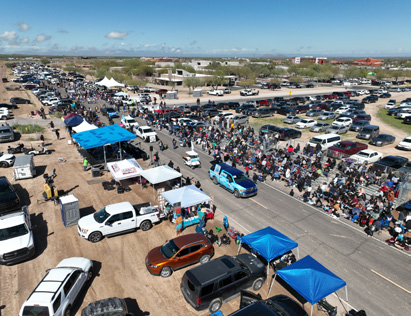
Fiber plays a key role in supporting Gila River tribal activities, such as the annual Mul-Chu-Tha Fair & Rodeo. Source: Gila River Telecommunications
Funding for the fiber build has come from a combination of tribal revenue, Universal Service Fund (USF) support, and some additional federal funding. Construction of the 475-mile main 400 Gbps network was completed in October 2025, with GRTI working to schedule its 60 remaining copper customers to switch to fiber, so it can finally decommission the last of its legacy hardware later this summer. “It costs money to continue to operate the legacy plant,” said Wierson. “We still need to respond if an existing copper customer goes down.”
Customers on the new fiber can get voice and data services, with Calix providing the CPE and supporting back-office systems. Residences can get up to 1 Gbps service today and the company plans to offer 2 Gbps services in the near future along with a home security camera package. Business customers can get up to 10 Gbps speeds.
“What makes our business unique is our advanced network and our staffing,” said Wierson. “Since we are owned by the tribe, we staff from the community and tribal members. Around 50% of our 107 employees are either from the Gila River community or other tribes.”
GRTI is a part of a group of tribal technology organizations supporting the community, including Native Technology Solutions structured cabling and special systems services; Gila River Broadcasting Corporation, a low power television station delivering both English and O’odham language programming; Alluvion Communications, a CLEC broadband service provider that operates outside tribal lands; and the Digital Connect Initiative, the tribal organization charged with promoting digital literacy and embracing technology as a resource for digital heritage preservation.
“The Digital Connect Initiative is pretty unique,” said Wierson. “It helps community members use the internet, provides one-on-one training sessions. It can provide laptops or other access devices to community members that need them.”
Community businesses GRTI supports include the tribe’s four casinos, health care locations, and tribal government agencies. GRTI provides and manages free Wi-Fi service available through the tribe’s 7 community centers as well as with fiber connectivity to a number of towers the company owns that support the tribe’s television broadcast operations and all major wireless carriers.
“We’re working on building 10 to 15 more towers serving tribal lands in the future, so we can create a more robust wireless network across the community,” said Wierson.
GRTI’s fiber is also providing support for the premium outlet mall and other businesses in Chandler, Arizona, with that sector expected to continue to grow over time. “We’re in a unique area; we’re rural, yet almost in the Phoenix metro area,” said Wierson. “Our location allows for affordable business locations that are close to Phoenix.”

Related Content
For tribal nations, sovereignty and the preservation of indigenous cultures is fundamentally intertwined with the scrutiny, acceptance, and adoption of the latest technologies. This path provides a sustainable bridge between generations while creating jobs and strengthening ownership and self-governance.
Alabama-based Dragonfly Internet is a relatively new service provider but traces back its leadership and experience roots to owner ITC Holding Company, LLC, a venture and management firm with decades of involvement in wireline, cellular, and internet service providers.
EPB started installing the first parts of its smart grid in 2009, leveraging an investment in fiber optics to ultimately connect 1,200 automated switches across its electrical plant along with over 200,000 smart meters across its 600 square-mile Chattanooga, Tennessee, service area. In its 15 years of operations, the smart grid delivered considerable benefits to EPB customers, including a 50-60% annual decrease in outage minutes that translated to up to $55 million in savings per year by helping them avoid spoilage of food, lost productivity due to the shutdown of equipment and ecommerce, and other negative impacts.