
U.S. Fiber Broadband Total Passings Reach 100M Mark


U.S. Fiber Broadband Total Passings Reach 100M Mark
The fiber broadband industry reached two significant milestones in 2025, according to the latest RVA research on fiber deployment released at the end of last year. First, the industry hit yet another yearly deployment record, with nearly 12 million homes passed in the United States as of September 2025, when RVA closed its annual reporting. Second, nearly 100 million fiber passings have taken place, marking over 60% of households that have access to reliable, high-speed, low-latency broadband.
RVA has been tracking the proliferation of fiber in the United States for over 20 years. “We get our data from many sources,” said Mike Render, CEO at RVA LLC Market Research and Consulting on a Fiber for Breakfast podcast discussing the latest results. “The government, FCC data, analysis that public companies release, multiple services we do and consumer services that are out there. It’s important to triangulate, because no source of data is perfect. Of course, our data isn’t perfect either, but we try our best to get things zeroed in as much as possible.”
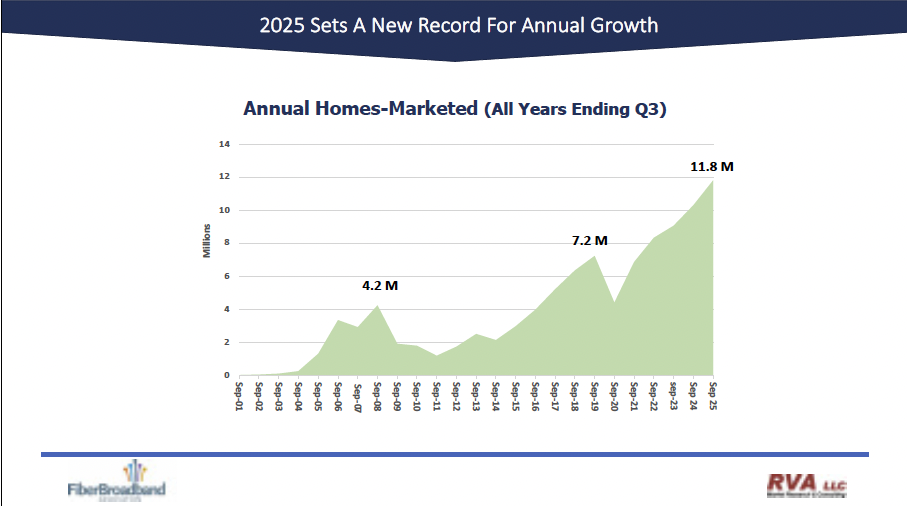
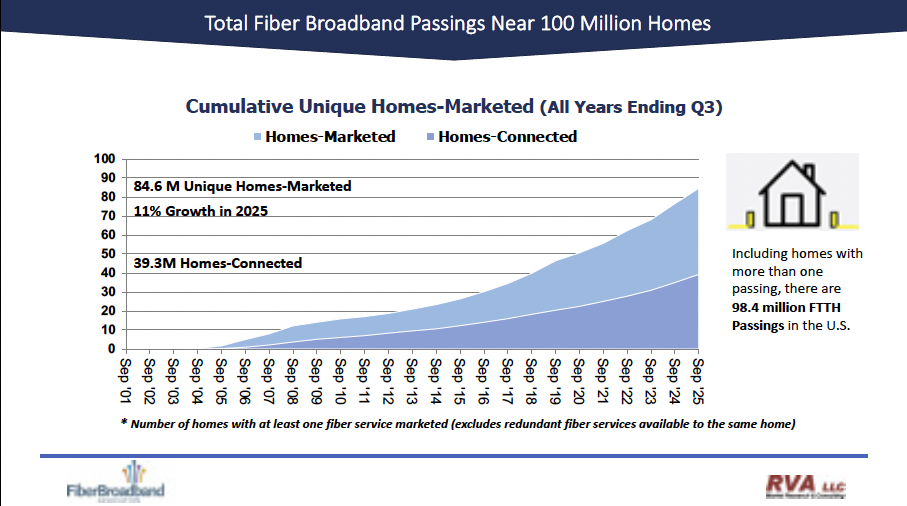
Fiber deployment numbers have been steadily increasing year over year for the last 10 years, except for 2020 due to the pandemic. Today, over 60% of U.S. households are passed with fiber, excluding second homes and short-term rentals.
“We have 84.6 million unique homes marketed,” Render stated. “The number of homes with redundant passings keeps increasing. We are now up to 16% that have more than one passing, with 15% at two and 1% at three or four. People are seeing the need to compete with fiber and go into certain [markets] with more than one fiber [service provider].”
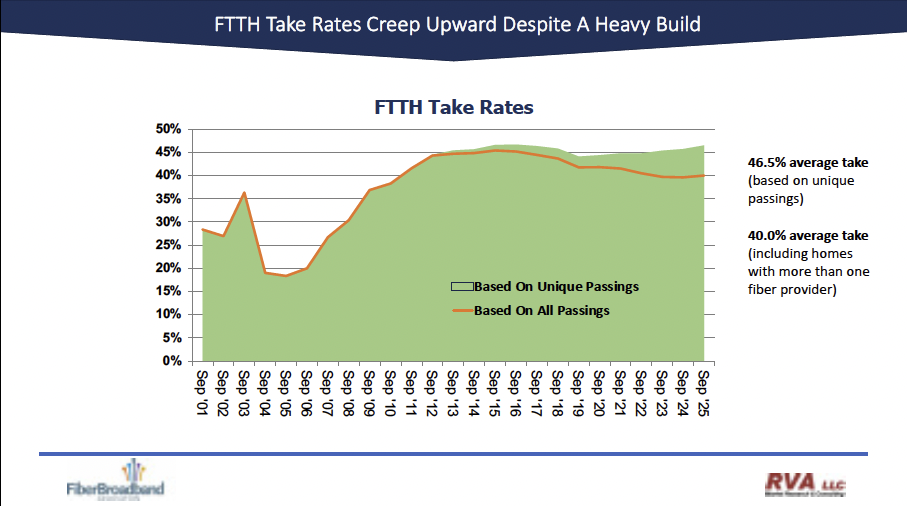
Render sees good progress towards FBA’s 2030 goals of 90% of U.S. homes to be passed and 50% of homes connected, noting that take rates for fiber service have also steadily risen over time. Average take rates for fiber are at 40% including homes with more than one fiber provider and at 46.5% average rate based on unique passings.
“It takes about five years once you build and start marketing for most of the homes passed to become actual connections,” said Render. “We are making much faster progress than previous wireline builds, such as copper telephone in the first part of the last century, coax in the middle of the last century.”
In comparison, fiber-to-the-home started in 2005, less than twenty years for a much more rapid buildout. The continued and successful increase of fiber passings and penetration is due to a number of factors, Render noted, including the efforts of the FBA, and a diverse and growing set of service providers deploying fiber beyond large telecoms. “In 2017, there were only 12% of other kinds of [Non-Tier 1] providers [other than telco],” he said. “Now it’s 40% competitive providers, from big players like Google and T-Mobile to very small wireless players who are getting involved in wireless.”
Other contributors to the fiber totals include cable companies increasing their fiber builds in greenfield and competitive areas, municipalities, electric cooperatives, and tier 2 and 3 telecoms, driven by consumer demand for more broadband and a clear preference for fiber over other services, as indicated by NPS scores.
Canada has also seen significant fiber penetration, with 12.4 million unique homes having access to fiber and 14.5 total passings, including homes with two or more providers, and 6.3 million homes connected. The Great White North in Canada is ahead of the U.S. percentage-wise, with nearly 75% of homes passed, but “from here on out it, it gets tougher [to reach more homes],” Render said, “their rural is much more rural than U.S. rural.”
Broadband Growth Demand Continues
Consumer demand for broadband and hence fiber is driven by several factors, according to RVA’s research, including the perception that high-quality internet is considered very important by nearly 80% of households and the amount of average U.S. household data moved per month continues to steadily increase year-over-year over the past two decades. Average household data per month measured by Open Vault and other sources between 2018 and 2025, started at over 200 GB/month and in 2025 is now approaching 700 GB/month.
By any comparable metric, fiber continues to deliver the best objective speeds and perceived best experience, according to RVA data, as it is delivering faster download and upload speeds. NPS scores for fiber over the past decade have always been substantially higher than any other alternative, with those scores continuing to both improve and outperform DSL, cable, and wireless options.
“Nearly 60% of those surveyed said fiber is the best option if it was available and costs were similar,” said Render. “One of the key differentiators for fiber broadband is upload speed. You can see from Open Vault data, the amount of [upload] increase is now way ahead of download speeds. It keeps increasing at a faster pace.”
AI is positioned to be a key driver in increasing upload speeds, as data from homes and businesses continues to flow from the edge to data centers for processing and storage across a wide range of applications. Always-on security cameras now process high-definition video to detect humans and animals, video is now used for remote-hands diagnosis and repairs across devices from vehicles to HVAC, while a steady stream of data comes from in-home health devices, appliances, and smart home monitoring sensors.
“ChatGPT says AI will likely increase two times to 10 times average [upload speeds] over the next five years,” said Render. “The fiber advantage of upload speeds becomes more and more important. The main point, as we’ve done in the previous whitepaper, is that it’s all about productivity. If you have don’t have [enough speed], you’re waiting two seconds here, two minutes there.”
Waiting for information to move back and forth across slower broadband translates to lower productivity that might be as much as 2-3 hours per day, adding up over weeks and months, while gigabit level connectivity cuts wait time for most of today’s tasks to seconds.
To 2026 and Beyond!
Render expects fiber construction to continue to grow over the next few years due to changes in tax laws and the release of NTIA BEAD funding into circulation.
“The new tax bill raised depreciation to 100%, which means companies can write off more of their capital investments and have more money to spend on capital investment,” said Render. “A lot of companies have already announced they are going to take advantage of the new laws and go up 5% to 10% in capital spend. The public investment, there’s still a lot out there and there are fairly large rural [networks] that [states] are building with pretty large matches involved with those projects. All that means is there is more pressure and opportunity to get more fiber out there. We’re seeing fiber winning wherever it is available.”

Related Content

Fiber for Breakfast Week 42: From Classical to Quantum: An Infrastructure Roadmap for Fiber Operators Quantum networking can sound like…
Fiber for Breakfast Week 40: Arkansas’s Broadband Momentum Arkansas entered this decade with a lot of broadband work left to…

For tribal nations, sovereignty and the preservation of indigenous cultures is fundamentally intertwined with the scrutiny, acceptance, and adoption of the latest technologies. This path provides a sustainable bridge between generations while creating jobs and strengthening ownership and self-governance.