
AI, Fiber, and Enablement of the Thinking Economy


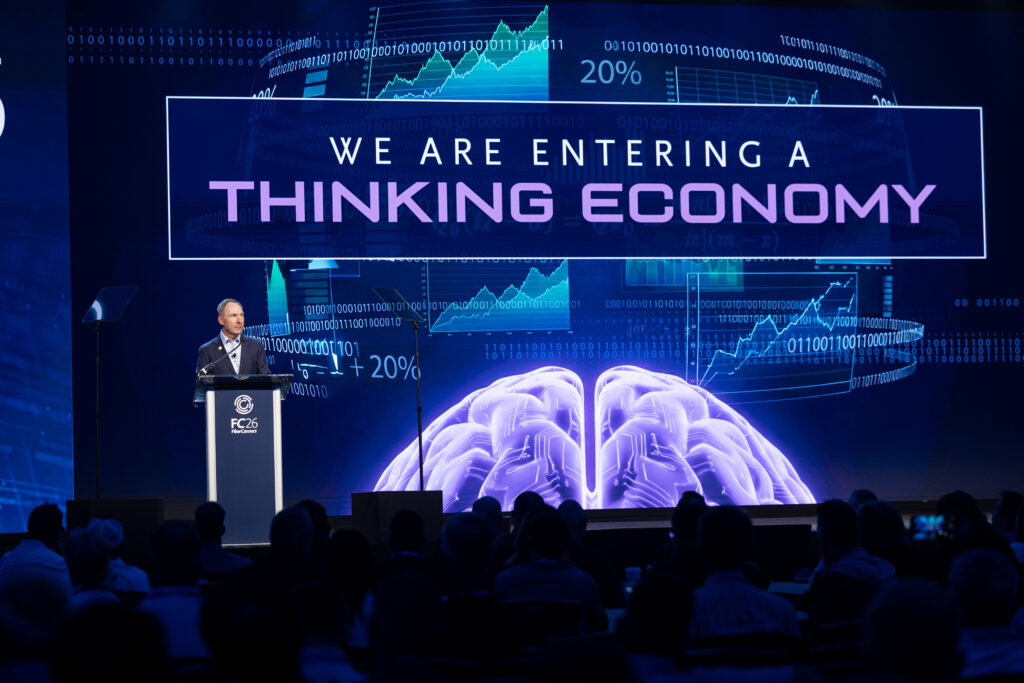
FBA President & CEO Gary Bolton introduced his “Thinking Economy” perspective on fiber serving as the infrastructure to next-gen innovation. Source: FBA
For decades, the broadband conversation has focused on connecting people, homes, schools, businesses, and communities to information. The Fiber Broadband Association has known this since our creation 25 years ago, as we built the nation’s 21st Century telecommunications infrastructure, enabling today’s information economy which drives society. Connectivity to everyone everywhere with reliable, resilient, unlimited high-speed bandwidth is an essential mission that we will continue to deliver upon in the years and decades to come.
However, the Artificial Intelligence (AI) era is rapidly changing the infrastructure equation andtransforming the information economy into a Thinking Economy. People aren’t simply moving bits from point A to point B but instead are leveraging AI to transform raw information into high-quality value, reducing cost, increasing productivity, and unlocking unprecedented opportunities for improving all business sectors and our individual daily lives.
AI’s thirst for resources continues to change the infrastructure equation. Intelligence depends on data centers, power, cooling, optical networks, and fiber. As AI becomes more distributed and real-time, fiber becomes the critical nervous system that allows the economy to sense, transmit, coordinate, and respond.
Even prior to AI becoming top-of-mind for corporations and governments, fiber was paving the way. Broadband investment remains at near-record levels, with U.S. broadband providers putting out nearly $90 billion dollars for communications infrastructure in 2025. The $42.45 billion in NTIA BEAD funding has been an important accelerator, but private capital and large operators continue to drive much of the nation’s fiber deployment, especially in the surging regional and middle mile growth for data center connectivity.
AI and fiber are becoming increasingly interdependent as data center interconnection, middle-mile capacity, edge connectivity, and resilient transport become essential to AI performance. AI cannot scale without high-capacity, low-latency, and resilient fiber networks. As intelligence moves from centralized training environments to distributed inference, edge systems, and real-time applications, fiber becomes even more valuable and more strategic.
As the U.S. experiences a historic fiber deployment cycle while AI infrastructure investment accelerates across data centers, cloud platforms, edge compute, and optical networking, the two can no longer be viewed separately. Power and fiber are shaping the geography of AI, as communities with both energy capacity and advanced fiber networks are better positioned to attract investment.
Against this backdrop, fiber is strategic economic infrastructure, supporting not only broadband access but also public safety, national security, grid modernization, industrial resilience, and future AI-enabled services. This is about more than least-cost broadband speed but ensuring access and future growth opportunities for all, utilizing proven, trusted technology.
Communities with fiber will be better positioned to participate in the Thinking Economy and reap its full benefits. Access to fiber is the entry point to rural hospitals accessing AI-enabled care, public safety systems responding securely and reliably in real time, and manufacturers modernizing and optimizing operations, with every community taking part in the next era of economic growth without limitations or constraints.
On FBA’s website, you’ll find “Building the Nervous System of a Thinking Economy: How the Convergence of Fiber Broadband and Artificial Intelligence is Reshaping Economic Infrastructure,” examining in greater detail how fiber broadband and artificial intelligence infrastructure are becoming increasingly interdependent and fiber’s contributions to enabling both AI and quantum technologies for the next generation of economic growth and productivity.If you are a policymaker or stakeholder in infrastructure, I strongly recommend that you read the white paper to understand the full implications of fiber and the Thinking Economy.
This article and similar stories can be found in the Q3 edition of the Fiber Forward Magazine.

Related Content
WASHINGTON, D.C.— (September 17, 2026)—The Fiber Broadband Association (FBA) today announced the launch of the AI & Quantum Infrastructure Pavilion…
Fiber for Breakfast: Beyond the Build: The Future of State Broadband For the last several years, state broadband offices have…

Most of us are familiar with telemedicine from the pandemic, when “seeing” a doctor in person was the last resort…