Make the most of FBA membership – or learn how to join.
Contact us at membership@fiberbroadband.org.
Powering the Network (Out & About)
Full House in Boston: FBA’s Fiber Policy Lab Sparks Conversations on Innovation and Connectivity


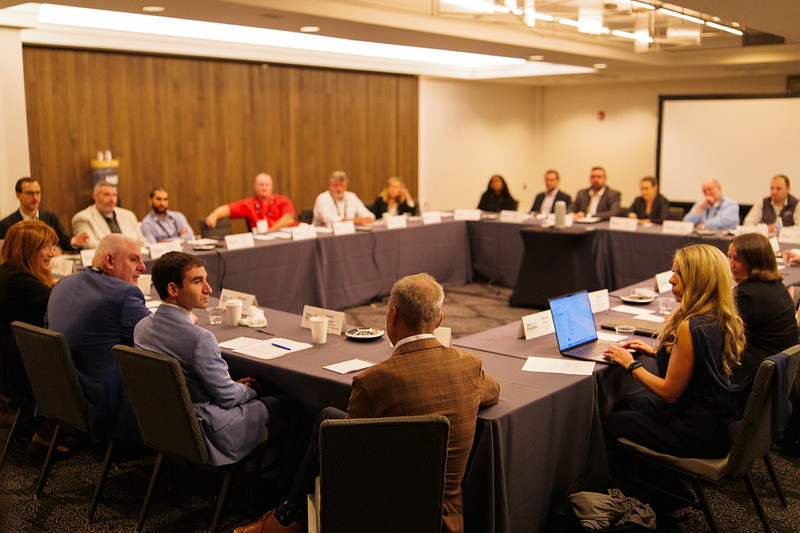
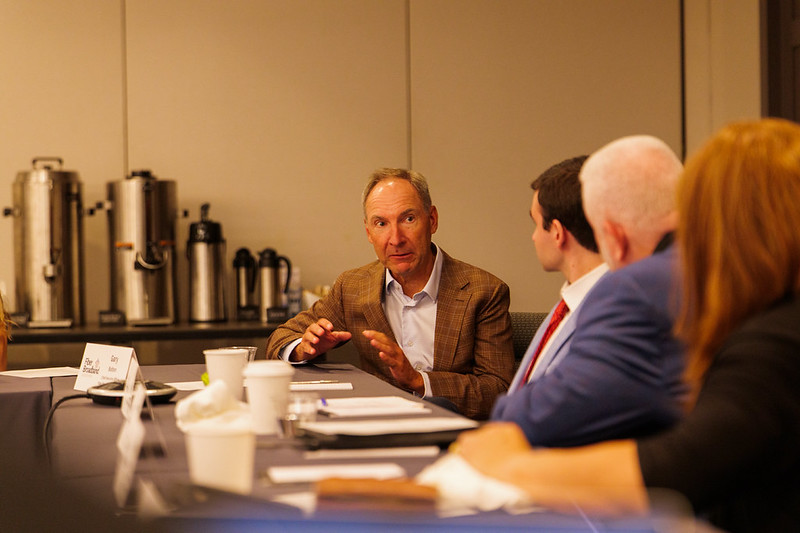
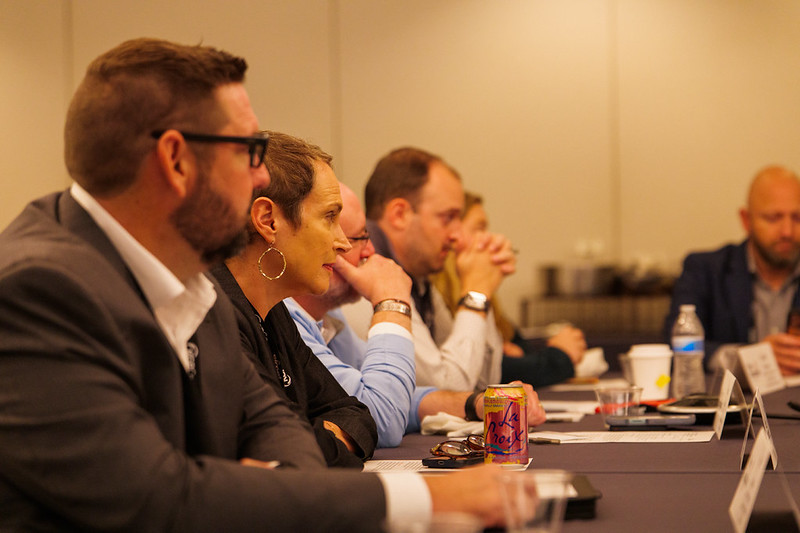
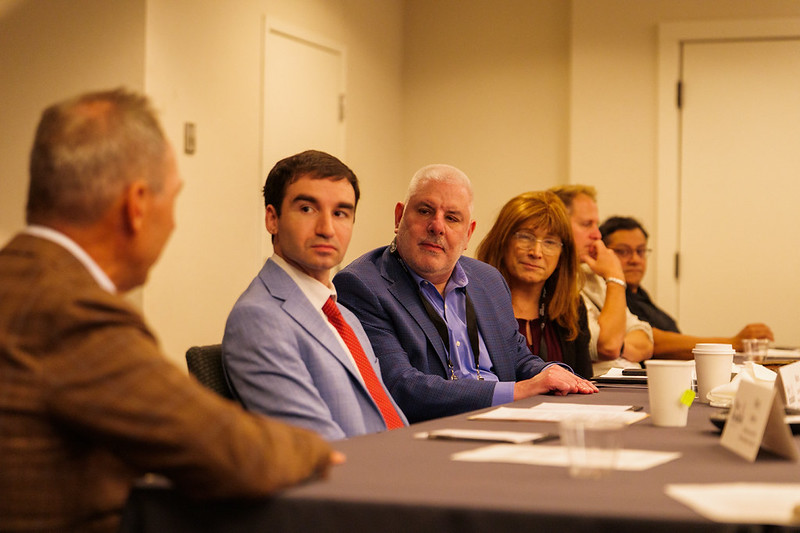
FBA brought its fifth Fiber Policy Lab of 2026 to Boston, convening a full house of industry leaders, public officials, and community stakeholders for candid conversations on the future of connectivity across Massachusetts and New England. Held alongside Boston’s Regional Fiber Connect, the invitation-only roundtable explored how fiber infrastructure enables the next wave of innovation, from universal connectivity to AI, quantum computing, and a high-tech workforce. Building on four successful stops across the country, the Boston gathering expanded FBA’s efforts to connect industry leaders with policymakers in their communities and foster dialogue on the opportunities shaping the region’s digital future.
FBA Partners with WTTP to Kick Off Legislative Conference Season
FBA partnered with the Women’s Tech & Telecom Partnership (WTTP) on September 14, to kick off the CBCF Annual Legislative Conference and CHCI Leadership Conference weeks and celebrate the women of the Congressional Black Caucus (CBC), Congressional Hispanic Caucus (CHC), and Congressional Asian Pacific American Caucus (CAPAC). The reception brought together members and staff shaping the future of technology, telecommunications, innovation, and public policy.
The event featured remarks from FCC Commissioner Gomez and also recognized her leadership and contributions to the communications sector. Guests gathered for an evening of networking, shopping, and conversation as the tri-caucus event got underway.
FBA Supports BWCA Brunch
FBA supported the Black Women’s Congressional Alliance (BWCA) brunch held at the British Ambassador’s Residence on Sunday, September 20, helping close out a busy CBC week. The gathering brought together Black women leaders from across government, policy, and communications for networking and conversation around their work in public service.
Events like these are an important part of building relationships across the policymaking community and engaging with the diverse congressional leaders and staff shaping the future of broadband, technology, and communications policy.
Light Byte:
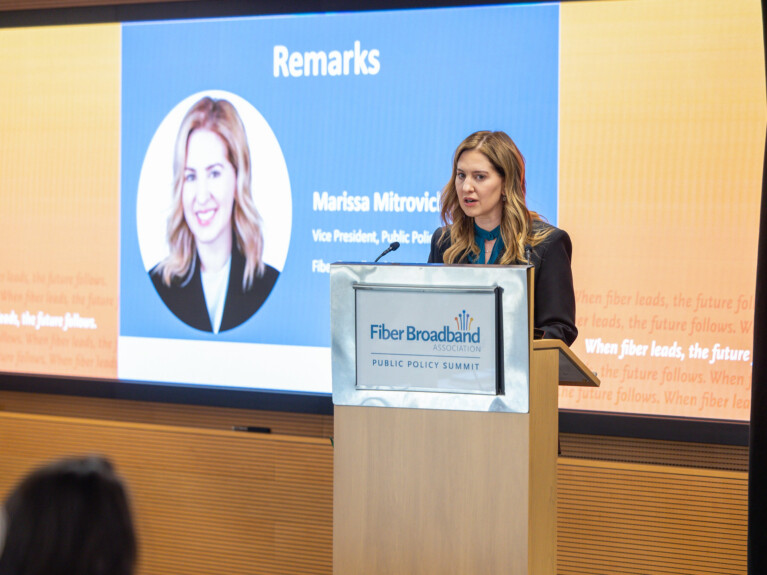
A New Chapter for FBA Public Policy: Thank You, Marissa, and Congratulations, Lukas!
As Marissa Mitrovich embarks on her next chapter, we celebrate her remarkable leadership in building FBA’s public policy program into a respected voice for fiber nationwide and assembling an exceptional team to carry that work forward. We thank her for her vision, dedication, and lasting contributions to our industry. As she passes the baton to Lukas Pietrzak, our new Interim Head of Public Policy, we look forward to building on the strong foundation she leaves behind.
Policy in the Conduit (Policy & Regulatory Updates)
FEDERAL POLICY
NTIA Opens Second BEAD Round for Locations Left Behind
On September 3rd, NTIA issued its first policy notice addressing BEAD “Benefit of the Bargain” savings, creating a supplemental deployment round for locations that remain unserved after the initial BEAD process. Eligible locations may include those left behind by defaults in other federal or state programs, removed during the original challenge process based on service claims that did not materialize, or newly identified through updates to the FCC’s broadband maps.
NTIA has provided each state and territory with an initial list of locations. States must review and publish the list, conduct a 30-day challenge process, and run a second Benefit of the Bargain round. Challenges may only remove locations, and providers must demonstrate that qualifying service exists or will be deployed within 12 months; an attestation or appearance on the FCC map alone will not suffice. The full process could take up to 277 days.
A central concern is whether the available funding will match the cost of reaching these locations. NTIA generally will cap each state’s allocation based on its average approved per-location cost multiplied by the number of eligible locations, although additional funding may be available in extraordinary circumstances. State broadband leaders warn that this formula could underfund harder-to-reach locations, particularly where lower-cost satellite awards reduce the statewide average. The Advanced Communications Law and Policy Institute estimates that approximately 1.04 million locations could qualify, requiring between $5.3 billion and $8.8 billion. NTIA has indicated that guidance for the remaining non-deployment funds will follow once it better understands the cost of this round, raising concerns that other planned broadband and infrastructure investments could face further delays.
BEAD Bottlenecks Shift to Poles and Local Permitting
Federal environmental reviews for BEAD projects are moving faster, but state broadband leaders say deployment delays are increasingly shifting to utility poles, rights-of-way, road permits, and local tower approvals. Louisiana, for example, is averaging just six days between submitting an environmental review and receiving a federal response, compared with reviews that once took roughly six months.
The progress comes as states and providers move from planning into construction. Virginia identified pole access and rights-of-way as its largest remaining obstacles, while Kansas is reworking approximately one-third of its awarded locations. The developments underscore that accelerating federal review alone will not ensure timely deployment if providers continue to face delays in obtaining pole attachments and state and local permits.
GAO Report Addresses Broadband Map Challenges and BEAD Monitoring
In a new report, the Government Accountability Office (GAO) recommended that the FCC conduct targeted outreach to smaller communities and providers about difficulties with the National Broadband Map challenge process. Stakeholders described the process as burdensome and unclear, particularly when challenging many locations in an area. GAO cautioned that these difficulties could limit the FCC’s ability to obtain accurate broadband availability data.
GAO also recommended that NTIA provide states and territories with more information on using data requests to monitor the financial sustainability of BEAD-funded projects. Separately, USDA officials reported that much of the $4.6 billion available through its Telecommunications Infrastructure loan program remains unallocated but expect interest to increase as grant funding winds down. The FCC and NTIA agreed with GAO’s recommendations.
CONGRESS
House Energy and Commerce Committee Advances Several Bipartisan Broadband and Telecom Bills
On September 16, the House Energy and Commerce Committee advanced 16 bills, covering a range of issues including artificial intelligence, broadband coordination and data, network security, robocalls, and satellite licensing. Several of the measures had been considered by the Communications and Technology Subcommittee earlier in September.
Notably, the PLAN for Broadband Act would direct the NTIA to develop a government-wide broadband strategy to improve coordination across more than 130 federal programs.
The Data BRIDGE Act would improve the collection and integration of broadband data for agricultural areas, ensuring rural and agricultural areas are accurately reflected on the FCC’s National Broadband Map. The package also includes measures addressing the FCC’s satellite and earth-station licensing process; foreign-originated robocalls; and risks associated with adversarial robotics.
The AI for Secure Networks Act would direct the Commerce Department to study how AI could strengthen the cybersecurity and resilience of telecommunications, emergency-alert, and public-safety networks, as well as how AI tools should be tested and secured.
Reps. Guthrie and Pallone Introduce FCC Covered List Bill
House Energy and Commerce Committee Chairman Brett Guthrie (R-KY) and Ranking Member Frank Pallone (D-NJ) introduced bipartisan legislation to increase transparency and congressional oversight of the FCC’s Covered List. The bill would require more frequent updates, give Congress advance notice of additions, strengthen coordination with the Commerce Department, and limit the list to technology tied to designated foreign adversaries.
Thumann Confirmation Hearing Likely Delayed Until November
The Senate Commerce Committee postponed Danielle Thumann’s September 17 confirmation hearing, due to her unexpected start to maternity leave. With the Senate now entering its October recess, the Committee is unlikely to reschedule the hearing before Election Day.
Chairman Ted Cruz has indicated that the Committee intends to hold the hearing expeditiously once Thumann’s maternity leave concludes, and Senate Republicans are still expected to pursue confirmation by year-end. Some Democrats and outside groups continue to urge Senate leaders to pair Thumann’s nomination with a Democratic FCC nominee. If confirmed, Thumann would give Republicans a 3-1 Commission majority. FBA supports Thumann’s confirmation and continues to advocate for a full functioning Commission.
Senate Agriculture Committee Advances Farm Bill 2.0
The Senate Agriculture Committee advanced the Agricultural Act of 2026, known as Farm Bill 2.0, on September 16. The bill includes provisions to codify USDA’s ReConnect Program and streamline its application process, changes intended to provide greater certainty for broadband investment in rural and hard-to-serve communities.
FBA welcomed the Committee’s action, to strengthen and provide greater certainty for the ReConnect Program, emphasizing the importance of high-capacity fiber networks to precision agriculture, artificial intelligence, telehealth, advanced manufacturing, and rural small businesses. FBA will continue to engage with Congress as the Farm Bill moves forward to support policies that strengthen rural broadband investment.
Schumer Seeks Classified Senate Briefing on AI Security Risks
Senate Democratic Leader Chuck Schumer called for an immediate classified briefing for all senators on the federal government’s approach to advanced AI risks and competition with China. He requested information from the Trump Administration on three areas: testing and safeguards for frontier AI models, controls intended to prevent advanced chips and semiconductor equipment from reaching China, and preparations for AI-enabled cyberattacks.
Telecommunications networks were among the critical infrastructure sectors Schumer identified as potential targets, alongside energy grids, hospitals, water systems, schools, and election infrastructure. Although the request does not create new requirements, it reflects growing congressional attention to how AI development, national security, export controls, and communications-network resilience intersect.
Senate Permitting Reform Talks Continue, but Pre-Midterm Vote Unlikely
Bipartisan Senate negotiations on an energy-permitting reform package remain active, but a vote before the midterm elections now appears unlikely. Senate Environment and Public Works Chair Shelley Moore Capito (R-WV ) and Ranking Member Sheldon Whitehouse (D-RI) continue to lead negotiations, with Senate Energy and Natural Resources Chair Mike Lee (R-Utah) and Ranking Member Martin Heinrich (D-N.M.) also involved. Negotiators say they are close to an agreement but need additional time to review the legislation with Senate Democrats and other stakeholders.
The package would address several federal and state permitting issues, including environmental reviews, interstate transmission approvals, and state authority over certain projects. Although focused on energy infrastructure, the negotiations remain relevant to broadband stakeholders because similar federal and state review processes can affect broadband infrastructure deployment.
Lawmakers Propose Superintelligence Ban and Federal AI Department
Sen. Bernie Sanders (I-VT) and Rep. Greg Casar (D-TX) introduced legislation that would prohibit the development of artificial superintelligence – not AI generally – and create a federal Department of AI to oversee advanced systems.
The proposal comes as AI executives and researchers increasingly warn Congress about the potential safety risks posed by rapidly advancing models.
FCC
FBA Files Reply Comments on FCC Covered List Proposals
The FCC is considering additional changes to its equipment-authorization framework intended to address logic-bearing components associated with entities on the Covered List. The proposals include new component, software, and firmware disclosure requirements, potential reauthorization obligations, and broader restrictions based on where equipment is produced.
Initial commenters warned that overly broad requirements could complicate equipment authorizations, require significant supply-chain changes, reduce product availability, and increase costs. FBA filed reply comments to bring the perspective of the full fiber broadband ecosystem – including companies that manufacture, purchase, deploy, and maintain communications equipment – into the proceeding. The filing addresses how changes at the equipment-authorization stage can affect product development, procurement, network operations, and broadband deployment.
USF Contribution Factor Reaches Record 42%
The proposed Universal Service Fund contribution factor will reach a record 42% in the fourth quarter, up from 38.8% in Q3 and 37% in Q2. The increase adds urgency to longstanding concerns about the sustainability of the mechanism used to fund universal service.
With the High-Cost Program accounting for roughly half of quarterly USF demand, the announcement places renewed focus on preserving support for rural connectivity while establishing a durable funding base for the program.
FBA Urges Predictable Timelines for Wireline Deployment
FBA filed comments supporting the FCC’s efforts to address state and local barriers that can delay or derail wireline network builds and to create a more predictable framework for deployment.
FBA supports a 120-day outer limit for reviewing large-scale public rights-of-way access requests, while emphasizing that routine or less complex requests should be completed sooner. Predictable timelines are critical for projects spanning multiple jurisdictions, where a delay in one community can disrupt an entire build.
FCC Set to Vote Today on Environmental Review Reforms
At today’s open meeting, FCC commissioners are scheduled to vote on a draft order revising the agency’s National Environmental Policy Act rules. If adopted, the order would codify the statutory definition of “major federal action,” clarify which FCC authorizations trigger environmental review, and streamline requirements for categorical exclusions, environmental assessments, and environmental impact statements.
An accompanying Further Notice of Proposed Rulemaking would seek comment on the FCC’s National Historic Preservation Act framework, including when spectrum licensing constitutes an “undertaking” subject to historic-preservation review and what additional changes could improve efficiency. These proceedings are particularly relevant to members because federal environmental and historic-preservation reviews can affect deployment timelines and compliance obligations.
The Commission’s agenda also includes items addressing 911 modernization, ultra-wideband rules, satellite spectrum, and consumer consent for robocalls.
FBA Files Reply Comments on the Future of the USF High-Cost Program
FBA filed reply comments with the FCC on September 3 regarding the future of the Universal Service Fund’s High-Cost Program. FBA emphasized the program’s continued importance in bringing reliable broadband and voice service to rural communities and urged the Commission to ensure that its standards keep pace with how consumers use broadband today.
FBA asked the FCC to look beyond speed alone and consider latency, reliability, and overall network performance. The Commission should verify that rural communities are receiving real, consistently achieved, high-quality service before reducing or eliminating support, as reported coverage alone does not necessarily mean that reliable service is being delivered. FBA also supported continuing existing A-CAM and CAF-BLS funding while the FCC develops a longer-term framework for the program.
STATES
Louisiana Clears Environmental Reviews for 50,000 BEAD Locations
Louisiana completed federally required environmental reviews for BEAD projects covering 50,000 locations – more than 40% of the approximately 124,000 locations approved statewide. Finalizing the reviews achieves a key preconstruction requirement as Louisiana advances its BEAD projects toward deployment.
Washington Advances BEAD Contracts Amid Rising Project Costs
Washington has signed final agreements with seven of its 26 BEAD grant recipients, and one fixed wireless project is nearing construction. Representing more than $165 million in combined public and private investment to connect 28,452 locations – 6,584 with fiber and 21,858 with wireless service, the agreements mark the state’s transition from project selection to implementation.
As the state moves from project selection toward construction, officials report that some awardees are facing higher-than-expected costs. Remaining subgrantees have until October 8 to sign their agreements.
California Finalizes $1.4 Billion BEAD Plan
The California Public Utilities Commission unanimously approved the state’s final BEAD proposal, which is expected to connect all 270,571 eligible locations. Fiber accounts for 52.9% of planned connections, followed by satellite at 27% and fixed wireless at 20.1%.
The vote came despite concerns from consumer advocates that federal funding conditions could limit California’s ability to enforce certain state requirements on BEAD subgrantees. Before funding can flow, Governor Gavin Newsom must sign the agreement with NTIA and the state must finalize its subgrantee agreements.
New Mexico Invests in Community Wi-Fi and Tribal Fiber Planning
New Mexico approved more than $5.9 million for nine American Rescue Plan-funded projects to expand public broadband access in parks, public housing, senior centers, and other community spaces. The projects will provide 100/20 Mbps service and are expected to benefit more than four million visitors, students, and residents annually.
The state also awarded the Pueblo of Zia $100,000 to support engineering and planning for fiber connections to 193 unserved locations and 12 tribal institutions.
FBA Files Comments in New Mexico’s Broadband Deployment and Affordability Proceeding
On September 21, FBA filed comments in the New Mexico Public Regulation Commission’s ongoing proceeding on implementing SB152. The rules will outline how the state plans to implement the new broadband deployment program for rural and hard-to-reach locations while also updating the state low-income phone subsidy program to include broadband services. You can read more from FBA’s comments here.
Mark Your Calendar
FBA Fiber Policy Lab Heads to Savannah
On October 27, FBA will host its Sixth Fiber Policy Lab during lunch at the Savannah Regional Fiber Connect. The policy lab will feature local, state, and federal leaders who are driving public awareness of broadband deployment projects. Members will be invited to share their perspectives and ask questions in a closed-door, off-the-record setting.
If you are interested in attending, please RSVP to Lukas Pietrzak at LPietrzak@fiberbroadband.org
We welcome your input.
Meet Your Public Policy Team

Lukas Pietrzak
Interim Head of Public Policy

Tinae Bluitt
Public Policy Manager

Jeanne Le Delaizir
GFiber Public Policy Fellow